1,830 posters, 67 videos, 75 audios, 29 topics, 22 sessions, 4,727 authors, 1,697 institutions
ePostersLive by SciGen Technologies S.A. All rights reserved.
RCOG World Congress 2023
June 12 - 14, 2023 | London, UK

EP.1673
Navigating Obstacles: The Challenge of Mirena Removal in a Complex Case
Poster Presenter
Authors
Affiliations
Part of Topic
Benign Gynaecology
Navigating Obstacles: The Challenge of Mirena Removal in a Complex Case
Mirena is a hormone-releasing intrauterine device (IUD) primarily used for contraception, reducing heavy menstrual bleeding, and treating certain uterine conditions. The removal of Mirena necessitates a thorough risk-benefit analysis, particularly in intricate cases with anatomical distortions, as improper handling could lead to complications.
The objective is to emphasize the importance of individualized planning and management when facing challenges in Mirena removal.
A 53-year-old patient with intellectual impairment, schizophrenia, and an abdominal hernia accompanied by severe chronic constipation presented by her carer for the removal of Mirena IUD, which had been in place for 7 years. Initially, the Mirena was inserted to manage heavy menstrual bleeding (HMB) following unsuccessful endometrial ablation. The IUD had effectively controlled her symptoms.
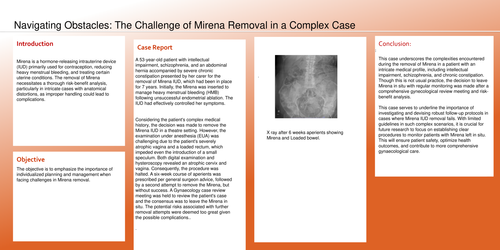
Considering the patient's complex medical history, the decision was made to remove the Mirena IUD in a theatre setting. However, the examination under anesthesia (EUA) was challenging due to the patient's severely atrophic vagina and a loaded rectum, which impeded even the introduction of a small speculum. Both digital examination and hysteroscopy revealed an atrophic cervix and vagina. Consequently, the procedure was halted. A six-week course of aperients was prescribed per general surgeon advice, followed by a second attempt to remove the Mirena, but without success. A Gynaecology case review meeting was held to review the patient's case and the consensus was to leave the Mirena in situ. The potential risks associated with further removal attempts were deemed too great given the possible complications..
.