1,830 posters, 67 videos, 75 audios, 29 topics, 22 sessions, 4,727 authors, 1,697 institutions
ePostersLive by SciGen Technologies S.A. All rights reserved.
RCOG World Congress 2023
June 12 - 14, 2023 | London, UK

EP.1668
Elective Caesarean Section, multiple fibroids , transverse lie, placenta previaMassive Obstetrics Hemorrhage.
Poster Presenter
Authors
Affiliations
Part of Topic
High Risk Pregnancy
Elective Cesarean section with multiple fibroids, placenta praevia, transverse lie, massive obstetric hemorrhage
Objectives
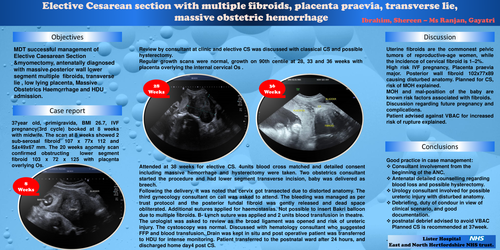
MDT successful management of Elective Caesarean Section &myomectomy, antenatally diagnosed with massive posterior wall lower segment multiple fibroids, transverse lie , low lying placenta, Massive Obstetrics Haemorrhage and HDU admission.
Case report
37 year old, primigravida, BMI 26.7, IVF pregnancy(3rd cycle) booked at 8 weeks with midwife. The scan at 8 weeks showed 2 sub-serosal fibroid 107 x 77x 112 and 54x49x67 mm. The 20 weeks anomaly scan confirmed obstructing lower segment fibroid 103 x 72 x 125 with placenta overlying Os.
Review by consultant at clinic and elective CS was discussed with classical CS and possible hysterectomy.
Regular growth scans were normal, growth on 90th centile at 28, 33 and 36 weeks with placenta overlying the internal cervical Os .
Attended at 38 weeks for elective CS. 4 units blood cross matched and detailed consent including massive hemorrhage and hysterectomy were taken. Two obstetrics consultant started the procedure and and had lower segment transverse incision, baby was delivered as breech.
Following the delivery, it was noted that cervix got transected due to distorted anatomy. The third gynecology consultant on call was asked to attend. The bleeding was managed as per trust protocol and the posterior fundal fibroid was gently released and dead space obliterated. Additional sutures applied for haemostasias. Not possible to insert Bakri balloon due to multiple fibroids. B- Lynch suture was applied and 2 units blood transfusion in theatre.
The urologist was asked to review as the broad ligament was opened and risk of ureteric injury. The cystoscopy was normal. Discussed with hematology consultant who suggested FFP and blood transfusion. Drain was kept in situ and post operative patient was transferred to HDU for intense monitoring. Patient transferred to the postnatal ward after 24 hours, and discharged home day4 post CS.
Discussion
Uterine fibroids are the commonest pelvic tumors of reproductive-age women, while the incidence of cervical fibroid is 1–2%.
High risk IVF pregnancy, Placenta praevia major. Posterior wall fibroid 102x77x89 causing disturbed anatomy. Planned for CS, risk of MOH explained.
MOH and mal-position of the baby are known risk factors associated with fibroids.
Discussion regarding future pregnancy and complications.
Patient advised against VBAC for increased risk of rupture explained.
Conclusion
Good practice in case management: