1,830 posters, 67 videos, 75 audios, 29 topics, 22 sessions, 4,727 authors, 1,697 institutions
ePostersLive by SciGen Technologies S.A. All rights reserved.
RCOG World Congress 2023
June 12 - 14, 2023 | London, UK

EP.1666
Assessing the Safety of hysteroscopic morcellation at Oxford University Hospital
Poster Presenter
Part of Topic
Hot Topics (Emerging research/issues) in Gynaecology
Assessing the Safety of hysteroscopic morcellation at Oxford University Hospital
Dr Elena Plesca, Dr Soma Roy-Chaudhuri, Miss Uloma Okwuosa, Oxford University Hospitals NHS Foundation Trust
Introduction and Objective
Hysteroscopic morcellation of submucosal uterine fibroids or endometrial polyps has a theoretical risk of disseminating malignant tissue through uterine perforation or retrograde flow through the fallopian tube. This risk is theoretical, in contrast to the recognized risk of dissemination in laparoscopic morcellation of fibroids, in which the morcellation takes place within the endometrial cavity.
We evaluated our current practice of hysteroscopic morcellation for:
- Provision of safe and effective treatment to patients with regards to complications and dissemination of malignancy.
- Rate of complete treatment in one clinic appointment.
- Identifying areas of improvement.
Design: Retrospective Trust-wide Departmental Audit. Data was collected over 6 months. The hysteroscopic morcellation procedures were performed by 6 clinicians at 2 hospital sites.
Methods
Data was collected from the Trust’s Electronic Patient Record system (Millennium Cerner) and analysed using NICE’s interventional procedure Outcomes Audit Tool.
Inclusion criteria:
Outpatient hysteroscopic procedures performed under local anaesthetic for:
Exclusion criteria: Hysteroscopic morcellation performed under general anaesthesia or size of polyp/fibroid >30 mm.
Results
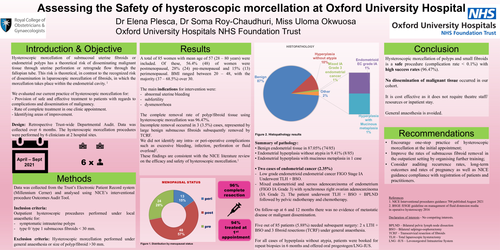
A total of 85 women with mean age of 57 (28 – 80 years) were included. Of these, 56.4% (48) of women were postmenopausal, 28% (24) pre-menopausal and 15% (13) perimenopausal. BMI ranged between 20 – 48, with the majority (37 – 68.5%) over 30.
The main indications for intervention were:
The complete removal rate of polyp/fibroid tissue using hysteroscopic morcellation was 96.47%.
Incomplete removal occurred in 3 (3.5%) cases, represented by large benign submucous fibroids subsequently removed by TCRF.
We did not identify any intra- or peri-operative complications such as excessive bleeding, infection, perforation or fluid overload.
These findings are consistent with the NICE literature review on the efficacy and safety of hysteroscopic morcellation.
Summary of pathology:
• Benign endometrial tissue in 87.05% (74/85)
• Endometrial hyperplasia without atypia in 9.41% (8/85)
• Endometrial hyperplasia with mucinous metaplasia in 1 case
• Two cases of endometrial cancer (2.35%)
- Low grade endometrioid endometrial cancer FIGO Stage IA Underwent TLH + BSO.
On follow-up at 6 and 12 months there was no evidence of metastatic disease or malignant dissemination.
Five out of 85 patients (5.88%) needed subsequent surgery: 2 x LTH + BSO and 3 fibroid resections (TCRF) under general anaesthesia.
For all cases of hyperplasia without atypia, patients were booked for repeat biopsies in 6 months and offered oral progestogen/LNG-IUS.
Conclusions
Hysteroscopic morcellation of polyps and small fibroids is a safe procedure (complication rate < 0.1%) with high success rates (96.47%).
No dissemination of malignant tissueoccurred in our cohort.
It is cost effective as it does not require theatre staff/ resources or inpatient stay.
General anaesthesia is avoided.
Recommendations