1,830 posters, 67 videos, 75 audios, 29 topics, 22 sessions, 4,727 authors, 1,697 institutions
ePostersLive by SciGen Technologies S.A. All rights reserved.
RCOG World Congress 2023
June 12 - 14, 2023 | London, UK

EP.0165
Antenatal Management of Hypothyroidism in a UK Tertiary Hospital
Poster Presenter
Part of Topic
Maternal Medicine
Antenatal Management of Hypothyroidism in a UK Tertiary Hospital.
BACKGROUND:
•Hypothyroidism affects approximately 1-2% of antenatal women.
•Poor control increases the risk of fetal compromise and maternal thyroid stimulating hormone (TSH) levels are monitored. There are no national guidelines for antenatal care of hypothyroidism.
•In our hospital, levothyroxine dose is prophylactically increased before booking and thyroid function test (TFT) checked at booking, 16, 20, 28 and 34/40, with additional TFTs requested 4weeks post-dosage changes.
AIM:
•Establish whether clinical practice was compliant with Trust guidelines
•Investigate the implications of thyroid control in pregnancy and optimal number of TFTs.
METHOD:
•All antenatal patients with hypothyroidism, managed at Birmingham Women’s Hospital (Birmingham, UK) between September 2019 - September 2020 were identified.
•All data were collected retrospectively from electronic records. Chi-squared test was used for statistical significance.
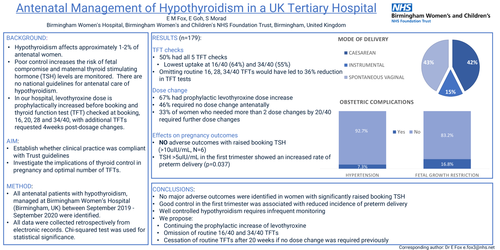
RESULTS (n=179):
TFT checks
•50% had all 5 TFT checks
•Lowest uptake at 16/40 (64%) and 34/40 (55%)
•Omitting routine 16, 28, 34/40 TFTs would have led to 36% reduction in TFT tests
Dose change
•67% had prophylactic levothyroxine dose increase
•46% required no dose change antenatally
•33% of women who needed more than 2 dose changes by 20/40 required further dose changes
Effects on pregnancy outcomes
•NO adverse outcomes with raised booking TSH
(>10uIU/mL, N=6)
•TSH >5uIU/mL in the first trimester showed an increased rate of preterm delivery (p=0.037)
CONCLUSIONS:
•No major adverse outcomes were identified in women with significantly raised booking TSH
•Good control in the first trimester was associated with reduced incidence of preterm delivery
•Well controlled hypothyroidism requires infrequent monitoring
•We propose:
•Continuing the prophylactic increase of levothyroxine
•Omission of routine 16/40 and 34/40 TFTs
•Cessation of routine TFTs after 20 weeks if no dose change was required previously