1,830 posters, 67 videos, 75 audios, 29 topics, 22 sessions, 4,727 authors, 1,697 institutions
ePostersLive by SciGen Technologies S.A. All rights reserved.
RCOG World Congress 2023
June 12 - 14, 2023 | London, UK

EP.1651
Subfertility isn’t a war but an awakening in developing countries.
Poster Presenter
Part of Topic
Reproductive Medicine/Assisted Reproduction
Subfertility isn’t a war but an awakening in developing countries
Abstract
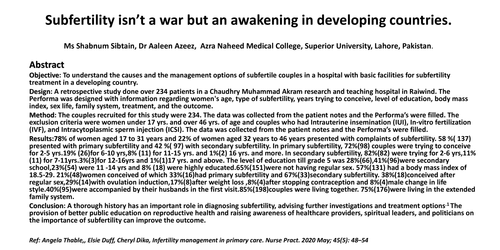
Objective: To understand the causes and the management options of subfertile couples in a hospital with basic facilities for subfertility treatment in a developing country.
Design: A retrospective study done over 234 patients in a Chaudhry Muhammad Akram research and teaching hospital in Raiwind. The Performa was designed with information regarding women's age, type of subfertility, years trying to conceive, level of education, body mass index, sex life, family system, treatment, and the outcome.
Method: The couples recruited for this study were 234. The data was collected from the patient notes and the Performa’s were filled. The exclusion criteria were women under 17 yrs. and over 46 yrs. of age and couples who had Intrauterine insemination (IUI), In-vitro fertilization (IVF), and Intracytoplasmic sperm injection (ICSI). The data was collected from the patient notes and the Performa’s were filled.
Results:78% of women aged 17 to 31 years and 22% of women aged 32 years to 46 years presented with complaints of subfertility. 58 %( 137) presented with primary subfertility and 42 %( 97) with secondary subfertility. In primary subfertility, 72%(98) couples were trying to conceive for 2-5 yrs.19% (26)for 6-10 yrs,8% (11) for 11-15 yrs. and 1%(2) 16 yrs. and more. In secondary subfertility, 82%(82) were trying for 2-6 yrs,11% (11) for 7-11yrs.3%(3)for 12-16yrs and 1%(1)17 yrs. and above. The level of education till grade 5 was 28%(66),41%(96)were secondary school,23%(54) were 11 -14 yrs and 8% (18) were highly educated.65%(151)were not having regular sex. 57%(131) had a body mass index of 18.5-29. 21%(48)women conceived of which 33%(16)had primary subfertility and 67%(33)secondary subfertility. 38%(18)conceived after regular sex,29%(14)with ovulation induction,17%(8)after weight loss ,8%(4)after stopping contraception and 8%(4)male change in life style.40%(95)were accompanied by their husbands in the first visit.85%(198)couples were living together. 75%(176)were living in the extended family system.
Conclusion: A thorough history has an important role in diagnosing subfertility, advising further investigations and treatment options.1 The provision of better public education on reproductive health and raising awareness of healthcare providers, spiritual leaders, and politicians on the importance of subfertility can improve the outcome.
Ref: Angela Thable,, Elsie Duff, Cheryl Dika, Infertility management in primary care. Nurse Pract. 2020 May; 45(5): 48–54