1,830 posters, 67 videos, 75 audios, 29 topics, 22 sessions, 4,727 authors, 1,697 institutions
ePostersLive by SciGen Technologies S.A. All rights reserved.
RCOG World Congress 2023
June 12 - 14, 2023 | London, UK

EP.1608
Taking a Public Health Approach to Problems in Maternity: A Suggested Framework
Poster Presenter
Authors
Affiliations
Part of Topic
Hot Topics (Emerging research/issues) in Obstetrics
Taking a Public Health Approach to Problems in Maternity: A Suggested Framework
French L
Leicester City Council Public Health
Introduction:
The NHS Long Term Plan acknowledges that in order to meet the challenges of the future, the NHS must ‘do things differently’, including a renewed focus on prevention and tackling health inequalities. The importance of ‘taking a public health approach’ is often emphasised, but what does this mean in practice?
The RCOG training curriculum1 suggests that clinicians should 'understand the impact of a patient’s social, economic and environmental context on their health' but without a technical understanding of the wider determinants of health and a useable framework to apply in practice, this knowledge can feel removed from everyday clinical work. With the recognition that women who live in deprived areas and women from black and Asian ethnic backgrounds disproportionately suffer adverse maternal health outcomes2, comes an appetite from the system to understand how to look beyond the individual patient in front of you and make a difference at population level.
Competencies in Practice (CiPs) numbers 13 and 14 from the 2019 RCOG Core Curriculum require that:
This poster seeks to introduce the reader to the concept of the wider determinants of health and the effect they have on overall health and wellbeing outcomes. It also offers a useable framework to use when thinking about problems in the wider public health context.
What makes us healthy?
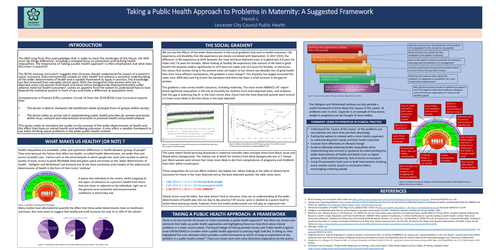
Health Inequalities are avoidable, unfair and systematic differences in health between groups of people3. They arise because the factors that affect our health, so-called health determinants, are wider than just access to health care. Factors such as the environments in which people live, work and socialise as well as quality of work, access to good affordable food and green space are known as the ‘wider determinants of health’. Dahlgren and Whitehead 4 put forward one of the most commonly used models of the wider/social determinants of health in the form of their iconic ‘rainbow’.
It places the individual at the centre, whilst mapping all the layers of influence on a person’s health from those that are closer or adjacent to the individual, right out to the general socio-economic and environmental conditions in which they live.
The social gradient
We can see the effects of the wider determinants in the social gradients that exist in health outcomes. Life expectancy and disability-free life expectancy are closely correlated with deprivation. In 2017-2019, the difference in life expectancy at birth between the most and least deprived areas in England was 9.4 years for males and 7.6 years for females. When looking at healthy life expectancy (the amount of life lived in good health) the disparity widens significantly to 19.0 years for males and 19.3 years for females. In real terms, this means that women living in the poorest areas can expect to live almost two decades less of good health than their more affluent counterparts; the gradient is even steeper6. This disparity has largely remained the same since 2009 data (see Fig 3)with the exception that there has been a small increase in the gap for women.
This gradient is seen across health outcomes, including maternity. The most recent MBRACE-UK7 report found significant inequalities in the risk of mortality for mothers from more deprived areas, and evidence that this gap is widening (Fig 4). In the most recent data, those from the most deprived quintile were around 2.5 times more likely to die than those in the least deprived
The same report found worrying disparities in maternal mortality rates amongst those from Black, Asian and Mixed ethnic backgrounds. The relative risk of death for mothers from Black backgrounds was 3.7. Simply put, Black women were almost four times more likely to die from complications of pregnancy and childbirth than their white counterparts.
These inequalities do not just affect mothers, but babies too. When looking at the odds of adverse birth outcomes for those in the most deprived versus the least deprived quintile, the odds ratios were:
Clearly action must be taken, but what action? And as clinicians, how can an understanding of the wider determinants of health play into our day to day practice? Of course, work is needed at a system level to tackle these worrying trends, however, front line health professionals can still play an important role.
There is no one-size-fits-all answer to ‘what constitutes a public health approach?’ but there are certain core elements that make up public health approaches and highlighting these can help think about clinical problems in a wider social context. The Royal College of Policing worked closely with Public Health England (now UKHSA/OHID) to consider what a public health approach to policing might look like. In doing so, they highlighted five core elements which provide a useful framework on which to hang an exploration of any problem in a public health context9. These are shown here with some illustrative explanation by the author.
Summary: Using PH principles in practice