1,830 posters, 67 videos, 75 audios, 29 topics, 22 sessions, 4,727 authors, 1,697 institutions
ePostersLive by SciGen Technologies S.A. All rights reserved.
RCOG World Congress 2023
June 12 - 14, 2023 | London, UK

EP.1598
Cultural and religious influences in shaping acceptance towards surrogacy in Sri Lanka
Poster Presenter
Authors
Janani Withana, Janith Gamage, Lakindu Grero, Akhila Munasinghe, Shamini Prathapan, Ramya Pathiraja, Dulanji Beneragama
Affiliations
Faculty of Medical Sciences, University of Sri Jayewardenepura, Department of Community Medicine, Faculty of Medical Sciences, University of Sri Jayewardenepura, Department of Obstetrics and Gynaecology, Faculty of Medical Sciences, University of Sri Jayewardenepura
Part of Topic
Reproductive Medicine/Assisted Reproduction
Cultural and religious influences in shaping acceptance towards surrogacy in Sri Lanka
Beneragama DM1, Grero KLW1, Gamage TGJN1, Munasinghe MAA1, Withana JL1, Pathiraja RP2, Prathapan S3
1Faculty of Medical Sciences, University of Sri Jayewardenepura, Sri Lanka; 2Department of Obstetrics and Gynaecology, Faculty of Medical Sciences, University of Sri Jayewardenepura, Sri Lanka; 3Department of Community Medicine, Faculty of Medical Sciences, University of Sri Jayewardenepura, Sri Lanka.
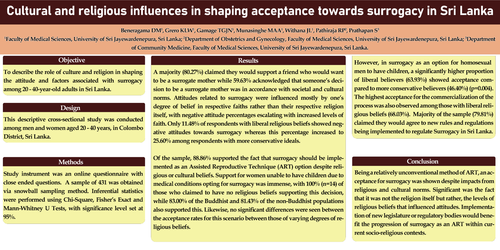
Objective: To describe the role of culture and religion in shaping the attitude and factors associated with surrogacy among 20 - 40-year-old adults in Sri Lanka.
Design: This descriptive cross-sectional study was conducted among men and women aged 20 - 40 years, in Colombo District, Sri Lanka.
Methods: Study instrument was an online questionnaire with close ended questions. A sample of 431 was obtained via snowball sampling method. Inferential statistics were performed using Chi-Square, Fisher’s Exact and Mann-Whitney U Tests, with significance level set at 95%.
Results: A majority (80.27%) claimed they would support a friend who would want to be a surrogate mother while 59.63% acknowledged that someone’s decision to be a surrogate mother was in accordance with societal and cultural norms. Attitudes related to surrogacy were influenced mostly by one’s degree of belief in respective faiths rather than their respective religion itself, with negative attitude percentages escalating with increased levels of faith. Only 11.48% of respondents with liberal religious beliefs showed negative attitudes towards surrogacy whereas this percentage increased to 25.60% among respondents with more conservative ideals.
Of the sample, 88.86% supported the fact that surrogacy should be implemented as an Assisted Reproductive Technique (ART) option despite religious or cultural beliefs. Support for women unable to have children due to medical conditions opting for surrogacy was immense, with 100%(n=14) of those who claimed to have no religious beliefs supporting this decision, while 83.00% of the Buddhist and 81.43% of the non-Buddhist populations also supported this. Likewise, no significant differences were seen between the acceptance rates for this scenario between those of varying degrees of religious beliefs. However, in surrogacy as an option for homosexual men to have children, a significantly higher proportion of liberal believers (63.93%) showed acceptance compared to more conservative believers (46.40%) (p=0.004). The highest acceptance for the commercialization of the process was also observed among those with liberal religious beliefs (68.03%). Majority of the sample (79.81%) claimed they would agree to new rules and regulations being implemented to regulate Surrogacy in Sri Lanka.
Conclusion: Being a relatively unconventional method of ART, an acceptance for surrogacy was shown despite impacts from religious and cultural norms. Significant was the fact that it was not the religion itself but rather, the levels of religious beliefs that influenced attitudes. Implementation of new legislature or regulatory bodies would benefit the progression of surrogacy as an ART within current socio-religious contexts.