1,830 posters, 67 videos, 75 audios, 29 topics, 22 sessions, 4,727 authors, 1,697 institutions
ePostersLive by SciGen Technologies S.A. All rights reserved.
RCOG World Congress 2023
June 12 - 14, 2023 | London, UK

EP.1597
The Impact of Anaemia on Major Obstetric Haemorrhage – A UK DGH Experience
Poster Presenter
Part of Topic
High Risk Pregnancy
The Impact of Anaemia on Major Obstetric Haemorrhage – A UK DGH Experience
Hossam Elnomrosy*, Mohammed Kalboush, Wafa Khan, Sukhera Furness
*Presenting author
Frimley Park NHS Foundation Trust Hospital, Portsmouth Road, Frimley, Camberley. GU16 7UJ
Objectives
Iron deficiency anaemia is a global problem, impacting around 279,000 pregnant women worldwide (WHO). Although it is more prevalent in low-resource countries, it is still an important issue in all healthcare systems. Effective management is required to reduce adverse maternal and pregnancy outcomes, particularly major obstetric haemorrhage (MOH) for which iron deficiency anaemia has been identified as a risk factor and is a major cause of morbidity. The purpose of this study is to identify whether our methods of screening for anaemia are effective, if our subsequent management meets local and national recommendations and whether this is a significant contributing factor to our MOH rates.
Design
Retrospective audit.
Methods
We identified 90 women over a 6-month period who had experienced a haemorrhage of 2L or more. We retrospectively identified whether they had been diagnosed with anaemia at any point during the pregnancy. We then assessed whether they had received appropriate treatment, follow up and advice in line with local and national guidance.
Results
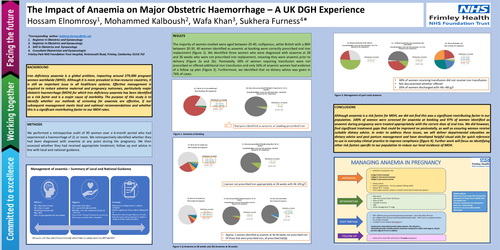
The majority of women studied were aged between 20-40, nulliparous, white British with a BMI between 20-30. All women identified as anaemic at booking were correctly prescribed oral iron replacement. We identified three women who were diagnosed with anaemia at 28 and 36 weeks who were not prescribed iron replacement, meaning they were anaemic prior to delivery. Postnatally, 38% of women requiring transfusion were not prescribed or offered additional iron transfusion and only 36% of anaemic women had evidence of a follow up plan. Furthermore, we identified that no dietary advice was given in 76% of cases.
Conclusions
Although anaemia is a risk factor for MOH, we did not find this was a significant contributing factor in our population. 100% of women were screened for anaemia at booking and 97% of women identified as anaemic during pregnancy were treated appropriately with the correct dose of oral iron. We did however, find significant treatment gaps that could be improved on postnatally, as well as ensuring women receive suitable dietary advice. In order to address these issues, we will deliver departmental education on dietary advice and post partum management and have developed helpful visual aids for quick reference to use in everyday clinical practice to improve compliance. Further work will focus on identifying other risk factors specific to our population to reduce our local incidence of MOH.