1,830 posters, 67 videos, 75 audios, 29 topics, 22 sessions, 4,727 authors, 1,697 institutions
ePostersLive by SciGen Technologies S.A. All rights reserved.
RCOG World Congress 2023
June 12 - 14, 2023 | London, UK

EP.1596
Compliance with screening of anemia in pregnant women in Dubai Hospital
Poster Presenter
Authors
Affiliations
Part of Topic
High Risk Pregnancy
Objectives
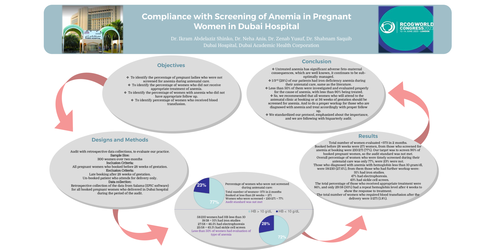
To identify the percentage of pregnant ladies who were not screened for anemia during antenatal care.
To identify the percentage of women who did not receive appropriate treatment of anemia.
To identify the percentage of women with anemia who did not have appropriate follow up.
To identify percentage of women who received blood transfusion.
Design & Method:
Audit with retrospective data collections, to evaluate our practice.
Sample Size: 300 women over two months
Inclusion Criteria: All pregnant women who booked before 28 weeks of gestation.
Exclusion Criteria:
- Late booking after 28 weeks of gestation.
- Un-booked patient who attends for delivery only.
Data collection: Retrospective collection of the data from Salama (EPIC software) for all booked pregnant women who delivered in Dubai hospital during the period of the audit.
Results
Total number of women evaluated =373 in 2 months.
Booked before 28 weeks were 271 women, from those who screened for anemia at booking were 210/271 (77%). Our target was to screen 90% of booked pregnant women, so the audit standard was not met.
Overall percentage of women who were timely screened during their antenatal care was only 77%, were 23% were not.
Those who diagnosed with anemia with hemoglobin less than 10 gram/dl, were 58/210 (27.6%), from them those who had further workup were:
31% had iron studies.
47% had electrophoresis.
43% had sickle cell screen.
The total percentage of those who received appropriate treatment were 86%, and only 29/58 (50%) had a repeat hemoglobin level after 4 weeks to show the response to treatment.
The total number of women who required blood transfusion after the delivery were 5/271 (1.8%).
Conclusions
Untreated anemia has significant adverse feto-maternal consequences, although those consequences are well known, it continues to be sub-optimally managed.
1/3rd (28%) of our patients had iron deficiency anemia during their antenatal care, same as the literature.
Less than 50% of them are investigated and evaluated properly for the cause of anemia, with less than 90% being treated.
So, we recommended that all women who attend to the antenatal clinic at booking or 36 weeks of gestation should be screened for anemia. And to do a proper workup for those who are diagnosed with anemia and treat accordingly with proper follow up.
We standardized our protocol, emphasized on our doctors about the importance, and we are doing biquarterly audit.