1,830 posters, 67 videos, 75 audios, 29 topics, 22 sessions, 4,727 authors, 1,697 institutions
ePostersLive by SciGen Technologies S.A. All rights reserved.
RCOG World Congress 2023
June 12 - 14, 2023 | London, UK

EP.0158
Daye Tampon as a vaginal sample collection tool for genital infection detection
Poster Presenter
Authors
Valentina Milanova, Kalina Mihaylova, Iva Lazarova, Nicola Tempest
Affiliations
Part of Topic
Benign Gynaecology
Audio
Daye Tampon as a vaginal sample collection tool for genital infection detection
Dr. Nicola Tempest, Valentina Milanova, Kalina Mihaylova, Iva Lazarova, University of Liverpool, Liverpool Womens’ Hospital
Introduction
The mechanisms by which female genital infections are detected are varied, and include clinician-collected high vaginal swab, clinician-collected endocervical swab, patient-collected vaginal swab, and first-pass urine sample.
Vaginal health screening has chronically low rates of uptake. This highlights the unmet need for a screening tool with comparable diagnostic accuracy to the golden standard,is familiar, convenient and easy to use by patients.
The Daye™ Diagnostic tampon offers an alternative to traditional sampling methods with the potential of increasing screening uptake, especially among people previously too embarrassed or busy to attend gynaecological appointments.
Methods
Comparative study: 83 patients were screened over 3 months. Samples were collected with sterile cervical swabs by a physician, self-collected with a vaginal swab and with Daye Diagnostic tampons. The tampons were inserted for 20 minutes.
All samples were tested for mRNA of characteristic microorganisms, found in the vaginal canal with the q-PCR Femoflor Screen assay. Acceptability of the three collection methods was assessed, the prevalence of the DNA load in our study population was estimated for: Total Bacterial Mass, Lactobacillus, Gardnerella vaginalis + Prevotella bivia + Porphyromonas spp., Candida spp., Ureaplasma spp.
Stability study: 21 volunteers were asked to wear a Daye menstrual tampon for 20 minutes followed by performing 2 lower vaginal swabs and completing a questionnaire. The swabs and tampon were transported directly to the laboratory (within 30 minutes) where they were processed immediately or frozen at -20°C for between 2-4 weeks.
Results & Discussion
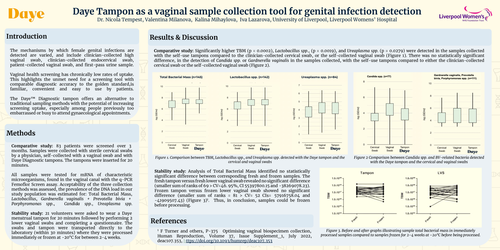
Comparative study: Significantly higher TBM (p = 0.0002), Lactobacillus spp., (p = 0.0019), and Ureaplasma spp. (p = 0.0279) were detected in the samples collected with the self-use tampons compared to the clinician-collected cervical swab, or the self-collected vaginal swab (Figure 1). There was no statistically significant difference, in the detection of Candida spp. or Gardnerella vaginalis in the samples collected, with the self-use tampons compared to either the clinician-collected cervical swab or the self-collected vaginal swab (Figure 2).
Stability study: Analysis of Total Bacterial Mass identified no statistically significant difference between corresponding fresh and frozen samples. The fresh tampon versus fresh lower vaginal swab revealed no significant difference (smaller sum of ranks of 69 > CV=46. 95%, CI 55397800.15 and -38269078.23). Frozen tampon versus frozen lower vaginal swab showed no significant difference (smaller sum of ranks = 81 > CV= 52 CIs= 57916758.04 and -41909507.43) (Figure 3)1. Thus, in conclusion, samples could be frozen before processing.