1,830 posters, 67 videos, 75 audios, 29 topics, 22 sessions, 4,727 authors, 1,697 institutions
ePostersLive by SciGen Technologies S.A. All rights reserved.
RCOG World Congress 2023
June 12 - 14, 2023 | London, UK

EP.1576
A Case Series of Non-descent Vaginal Hysterectomies
Poster Presenter
Part of Topic
Benign Gynaecology
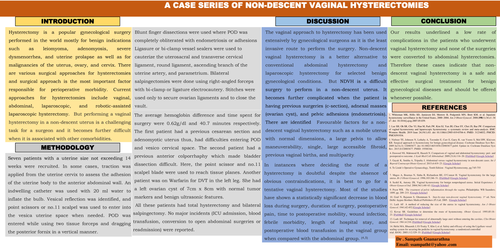
A CASE SERIES OF NON-DESCENT VAGINAL HYSTERECTOMIES
INTRODUCTION
Hysterectomy is a popular gynecological surgery performed in the world mostly for benign indications such as leiomyoma, adenomyosis, severe dysmenorrhea, and uterine prolapse as well as for malignancies of the uterus, ovary, and cervix. There are various surgical approaches for hysterectomies and surgical approach is the most important factor responsible for perioperative morbidity. Current approaches for hysterectomies include vaginal, abdominal, laparoscopic, and robotic-assisted laparoscopic hysterectomy. But performing a vaginal hysterectomy in a non-descent uterus is a challenging task for a surgeon and it becomes further difficult when it is associated with other comorbidities.
METHODOLOGY
Seven patients with a uterine size not exceeding 14 weeks were recruited. In some cases, traction was applied from the uterine cervix to assess the adhesion of the uterine body to the anterior abdominal wall. An indwelling catheter was used with 20 ml water to inflate the bulb. Vesical reflection was identified, and point scissors or no.11 scalpel was used to enter into the vesica uterine space when needed. POD was entered while using two tissue forceps and dragging the posterior fornix in a vertical manner.
Blunt finger dissections were used where POD was completely obliterated with endometriosis or adhesions Ligasure or bi-clamp vessel sealers were used to cauterize the uterosacral and transverse cervical ligament, round ligament, ascending branch of the uterine artery, and parametrium. Bilateral salpingectomies were done using right-angled forceps with bi-clamp or ligature electrocautery. Stitches were used only to secure ovarian ligaments and to close the vault.
The average hemoglobin difference and time spent for surgery were 0.62g/dl and 40.7 minutes respectively. The first patient had a previous cesarean section and adenomyotic uterus thus, had difficulties entering POD and vesico cervical space. The second patient had a previous anterior colporrhaphy which made bladder dissection difficult. Here, the point scissor and no.11 scalpel blade were used to reach tissue planes. Another patient was on Warfarin for DVT in the left leg. She had a left ovarian cyst of 7cm x 8cm with normal tumor markers and benign ultrasonic features.
All these patients had total hysterectomy and bilateral salpingectomy. No major incidents (ICU admission, blood transfusion, conversion to open abdominal surgeries or readmission) were reported.
DISCUSSION
The vaginal approach to hysterectomy has been used extensively by gynecological surgeons as it is the least invasive route to perform the surgery. Non-descent vaginal hysterectomy is a better alternative to conventional abdominal hysterectomy and laparoscopic hysterectomy for selected benign gynecological conditions. But NDVH is a difficult surgery to perform in a non-descent uterus. It becomes further complicated when the patient is having previous surgeries (c-section), adnexal masses (ovarian cyst), and pelvic adhesions (endometriosis). There are identified Favourable factors for a non-descent vaginal hysterectomy such as a mobile uterus with normal dimensions, a large pelvis to allow maneuverability, single, large accessible fibroid, previous vaginal births, and multiparity.
In instances where deciding the route of a hysterectomy is doubtful despite the absence of obvious contraindications, it is best to go for a tentative vaginal hysterectomy. Most of the studies have shown a statistically significant decrease in blood loss during surgery, duration of surgery, postoperative pain, time to postoperative mobility, wound infection, febrile morbidity, length of hospital stay, and postoperative blood transfusion in the vaginal group when compared with the abdominal group. (4,5)
CONCLUSION
Our results underlined a low rate of complications in the patients who underwent vaginal hysterectomy and none of the surgeries were converted to abdominal hysterectomies. Therefore these cases indicate that non-descent vaginal hysterectomy is a safe and effective surgical treatment for benign gynecological diseases and should be offered whenever possible.
REFERENCES
1. Whiteman MK, Hillis SD, Jamieson DJ, Morrow B, Podgornik MN, Brett KM, et al. Inpatient hysterectomy surveillance in the United States, 2000–2004. Am J Obstet Gynecol. 2008;198(1):34 e1–34 e7. doi: 10.1016/j.ajog.2007.05.039.
2. Lee SH, Oh SR, Cho YJ, Han M, Park JW, Kim SJ, Yun JH, Choe SY, Choi JS, Bae JW. Comparison of vaginal hysterectomy and laparoscopic hysterectomy: a systematic review and meta-analysis. BMC Womens Health. 2019 June 24;19(1):83. doi 10.1186/s12905-019-0784-4. PMID: 31234852; PMCID: PMC6591934.
3. Nieboer TE, Johnson N, Lethaby A, Tavender E, Curr E, Garry R, van Voorst S, Mol BW, Kluivers KB. Surgical approach to hysterectomy for benign gynecological disease. Cochrane Database Syst Rev. 2009 Jul 8;(3): CD003677. doi 10.1002/14651858.CD003677.pub4. Update in: Cochrane Database Syst Rev. 2015;8:CD003677. PMID: 19588344.
4. Dawood NS, Mahmood R, Haseeb N. Comparison of vaginal and abdominal hysterectomy: peri- and postoperative outcome. J Ayub Med Coll Abbottabad. 2009;21(4):116–20. [PubMed] [Google Scholar]
5. Gayak K, Smitha A, Tripathy J. Abdominal versus vaginal hysterectomy in non-descent cases. Int J Reprod Contracept Obstet Gynecol. 2015;4:419–23. [Google Scholar]
6. Te Linde’s Operative Gynaecology, Tenth Edition –Vaginal Hysterectomy, pg:745-755
7. Magos A, Bournas N, Sinha R, Richardson RE, O’Connor H. Vaginal hysterectomy for the large uterus. Br J Obstet Gynaecol. 1996;103:246–51. [PubMed] [Google Scholar]
8. Sushil K, Antony ZK. Vaginal hysterectomy for benign nonprolapsed uterus. Initial Experience. J Obstet Gynaecol Ind. 2004;54(1):60–63. [Google Scholar]
9. Pryor WR. The treatment of pelvic inflammation through the vagina. Philadelphia: WB Saunders; 1899. pp. 209–215. [Google Scholar]
10. Goel N, Rajaram S, Ghummam S. Step-by-step non-descent vaginal hysterectomy. 1st ed. New Delhi: Jaypee Brothers Medical Publishers (P) Ltd; 2005. [Google Scholar]
11. Lash AF. A method of reducing the size of the uterus in vaginal hysterectomy. Am J Obstet Gynecol. 1941;42:452.[Google Scholar]
12. Kovac SR. Guidelines to determine the route of hysterectomy. Obstet Gynecol. 1995;85:18–23. [PubMed] [Google Scholar]
13. Lash AF. Technique for removal of abnormally large uteri without entering the cavities. Clin Obstet Gynecol. 1961;4:210. [PubMed] [Google Scholar]
14. Hefni MA, Bhaumik J, El-Touky T, Kho I, et al. Safety and efficacy of using the LigaSure vessel sealing system for securing the pedicles in vaginal hysterectomy: a randomized controlled trial. BJOG. 2005;112:329–33. [PubMed] [Google Scholar]