1,830 posters, 67 videos, 75 audios, 29 topics, 22 sessions, 4,727 authors, 1,697 institutions
ePostersLive by SciGen Technologies S.A. All rights reserved.
RCOG World Congress 2023
June 12 - 14, 2023 | London, UK

EP.1568
A Body Stalk Anomaly with Accreta Placenta Spectrum Case: A Rare Entity
Poster Presenter
Authors
Fatima Zahra, Nathania -, Alfonsus Zeus Suryawan, Setyorini Irianti
Affiliations
Part of Topic
Fetal Medicine
A Body Stalk Anomaly with Accreta Placenta Spectrum Case: A Rare Entity
Fatima Zahra, Nathania, Alfonsus Zeus, Setyorini Irianti
Obstetrics and Gynecology Department, Hasan Sadikin Hospital
Objectives:
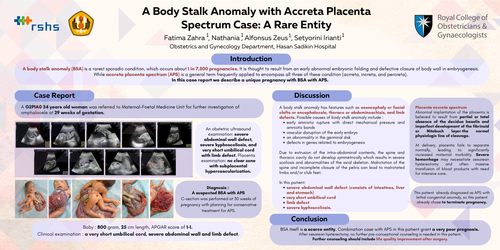
A body stalk anomaly (BSA) is a rarest sporadic condition, which occurs about 1 in 7,500 pregnancies and is thought to result from an early abnormal embryonic folding and defective closure of body wall in embryogenesis. While accreta placenta spectrum (APS) is a general term frequently applied to encompass all three of these condition (accreta, increta and percreta). Abnormal implantation of the placenta is believed to result from partial or total absence of the decidua basalis and imperfect development of the fibrinoid or Nitabuch layer-the normal physiologic line of cleavage. In this case report, we describe a unique pregnancy with BSA with APS.
Case Report:
A G2P1A0 34 years old woman was referred to Maternal-Foetal Medicine Unit for further investigation of omphalocele at 29 weeks of gestation. An obstetric ultrasound was performed with the result of severe abdominal wall defect, severe kyphoscoliosis, and very short umbilical cord with limb defect. Placenta examination on ultrasound reveals no clear zone with subplacental hypervascularization. The patient then was diagnosed as a suspected BSA with APS. C-section was performed at 30 weeks of pregnancy with planning for conservative treatment for APS. An 800 gram and 25 cm in length baby was born with APGAR score of 1-1. Clinical examination showed a very short umbilical cord, severe abdominal wall and limb defect.
Discussion:
In this case, there was no significant risk factor associated with family history or environmental exposure to teratogens. Obstetrical history reveals previous normal pregnancy terminated with c-section due to contracted pelvis. Conservative surgery for accreta placenta spectrum was tried to performed, but due to massive post partum hemorrhage, a subtotal hysterectomy was performed.
Conclusions:
In conclusion, the management of BSA with APS is more challenging. A preconception counselling is important to detect abnormalities earlier and a multidisciplinary care team is also needed in order to bring patients’ treatment plan. This congenital defect is invariably lethal.
keywords: body stalk anomaly, accreta placenta spectrum