1,830 posters, 67 videos, 75 audios, 29 topics, 22 sessions, 4,727 authors, 1,697 institutions
ePostersLive by SciGen Technologies S.A. All rights reserved.
RCOG World Congress 2023
June 12 - 14, 2023 | London, UK

EP.0155
Increased vaginal birth after caesarean with continuity model of care
Poster Presenter
Authors
Georgina Facchetti, Zhen Teo, Aaron Budden, Samuel Billyard, Meenu Sharma
Affiliations
Part of Topic
Labour Ward Management
Increased vaginal birth after caesarean with continuity model of care
Facchetti G, Teo Z, Billyard S, Budden A, Sharma M - Mid North Coast Local Health District, Australia
Objective
To determine if women attempting vaginal birth after caesarean (VBAC) were more likely to be successful with continuity antenatal and intraparum care compared to pooled care in regional Australian hospitals. Secondary objective is to determine if there is a difference in the proportion of women attempting VBAC between those models of care.
Design
Retrospective cohort of all women who birthed with 1 or more previous caesarean from January 2021 to January 2022.
Method
Eligible women were identified from a large patient data source (eMaternity) over 2 regional hospitals including the antenatal record of care and birth summary. Women were included if they had 1 or more caesarean. Women were excluded if they had obstetric (including more than 2 caesarean), fetal, placental, or medical contraindications to VBAC, or where the primary caesarean was for previous obstetric trauma. Continuity included midwifery group practice and private obstetric care. Non-continuity included pooled medical or midwifery clinic. High risk women were defined as having a risk factor which reduced the likelihood of VBAC success (1). Ethical approval was obtained by the local ethics review board: QA2022_02 HREC Exemption.
Results
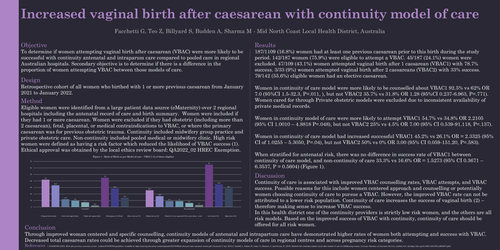
187/1109 (16.8%) women had at least one previous caesarean prior to this birth during the study period. 142/187 women (75.9%) were eligible to attempt a VBAC. 45/187 (24.1%) women were excluded. 47/109 (43.1%) women attempted vaginal birth after 1 caesarean (VBAC1) with 78.7% success. 3/33 (9%) women attempted vaginal birth after 2 caesareans (VBAC2) with 33% success. 79/142 (55.6%) eligible women had an elective caesarean.
Women in continuity of care model were more likely to be counselled about VBAC1 92.5% vs 62% OR 7.0 (95%CI 1.5-32.3, P=.011, ), but not VBAC2 35.7% vs 31.8% OR 1.28 (95%CI 0.237-6.963, P=.771). Women cared for through Private obstetric models were excluded due to inconsistent availability of private medical records.
Women in continuity model of care were more likely to attempt VBAC1 54.7% vs 34.8% OR 2.2105 (95% CI 1.0010 – 4.8818 P=.048), but not VBAC2 25% vs 4.5% OR 7.00 (95% CI 0.539-91.118, P=.137).
Women in continuity of care model had increased successful VBAC1 45.2% vs 26.1% OR = 2.3325 (95% CI of 1.0255 – 5.3050, P=.04), but not VBAC2 50% vs 0% OR 3.00 (95% CI 0.059-151.20, P=.583).
When stratified for antenatal risk, there was no difference in success rate of VBAC1 between continuity of care model, and non-continuity of care 33.3% vs 16.6% OR = 1.5273 (95% CI 0.3671 – 6.3537, P = 0.5604) (Figure 1).
Discussion
Continuity of care is associated with improved VBAC counselling rates, VBAC attempts, and VBAC success. Possible reasons for this include women centered approach and counselling or potentially women choosing continuity of care to pursue a VBAC. However, the improved VBAC rate can not be attributed to a lower risk population. Continuity of care increases the success of vaginal birth (2) – therefore making sense to increase VBAC success.
In this health district one of the continuity providers is strictly low risk women, and the others are all risk models. Based on the improved success of VBAC with continuity, continuity of care should be offered for all risk women.
Conclusion
Through improved woman centered and specific counselling, continuity models of antenatal and intrapartum care have demonstrated higher rates of women both attempting and success with VBAC. Decreased total caesarean rates could be achieved through greater expansion of continuity models of care in regional centres and across pregnancy risk categories.
References – 1. RANZCOG (2019). Birth after previous caesarean section . [online] RANZCOG guidelines. Available at: https://ranzcog.edu.au/wp-content/uploads/2022/05/Birth-after-previous-caesarean-section.pdf [Accessed 21 Apr. 2023].2. Sandall, J., Soltani, H., Gates, S., Shennan, A. and Devane, D. (2016). Midwife-led continuity models versus other models of care for childbearing women. Cochrane Database of Systematic Reviews, [online] 4(4). doi:https://doi.org/10.1002/14651858.cd004667.pub5.