1,830 posters, 67 videos, 75 audios, 29 topics, 22 sessions, 4,727 authors, 1,697 institutions
ePostersLive by SciGen Technologies S.A. All rights reserved.
RCOG World Congress 2023
June 12 - 14, 2023 | London, UK

EP.1562
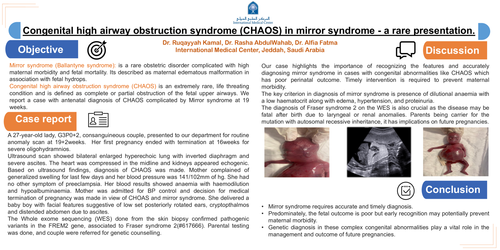
CHAOS (Congenital high airway obstruction syndrome) in mirror syndrome– a rare presentation.
Poster Presenter
Authors
Affiliations
Part of Topic
Fetal Medicine
Objective
Mirror syndrome (Ballantyne syndrome): is a rare obstetric disorder complicated with high maternal morbidity and fetal mortality. Its described as maternal edematous malformation in association with fetal hydrops.
Congenital high airway obstruction syndrome (CHAOS) is an extremely rare, life threating condition and is defined as complete or partial obstruction of the fetal upper airways. We report a case with antenatal diagnosis of CHAOS complicated by Mirror syndrome at 19 weeks.
Case Report
A 27-year-old lady, G3P0+2, consanguineous couple, presented to our department for routine anomaly scan at 19+2weeks. Her first pregnancy ended with termination at 16weeks for severe oligohydramnios.
Ultrasound scan showed bilateral enlarged hyperechoic lung with inverted diaphragm and severe ascites. The heart was compressed in the midline and kidneys appeared echogenic. Based on ultrasound findings, diagnosis of CHAOS was made. Mother complained of generalized swelling for last few days and her blood pressure was 141/102mm of hg. She had no other symptom of preeclampsia. Her blood results showed anaemia with haemodilution and hypoalbuminaemia. Mother was admitted for BP control and decision for medical termination of pregnancy was made in view of CHOAS and mirror syndrome. She delivered a baby boy with facial features suggestive of low set posteriorly rotated ears, cryptopthalmos and distended abdomen due to ascites.
The Whole exome sequencing (WES) done from the skin biopsy confirmed pathogenic variants in the FREM2 gene, associated to Fraser syndrome 2(#617666). Parental testing was done, and couple were referred for genetic counselling.
Discussion
Our case highlights the importance of recognizing the features and accurately diagnosing mirror syndrome in cases with congenital abnormalities like CHAOS which has poor perinatal outcome. Timely intervention is required to prevent maternal morbidity.
The key criterion in diagnosis of mirror syndrome is presence of dilutional anaemia with a low haematocrit along with edema, hypertension, and proteinuria.
The diagnosis of Fraser syndrome 2 on the WES is also crucial as the disease may be fatal after birth due to laryngeal or renal anomalies. Parents being carrier for the mutation with autosomal recessive inheritance, it has implications on future pregnancies.
Conclusion