1,830 posters, 67 videos, 75 audios, 29 topics, 22 sessions, 4,727 authors, 1,697 institutions
ePostersLive by SciGen Technologies S.A. All rights reserved.
RCOG World Congress 2023
June 12 - 14, 2023 | London, UK

EP.1551
Hemorrhagic ovarian cyst
Poster Presenter
Authors
Affiliations
Part of Topic
Fetal Medicine
Case Report Objective:
An ovarian cyst is the most common abdominal mass found in a female foetus. They can be complicated by ovarian accidents such as haemorrhage, rupture or torsion, with sequelae like anaemia or ascites. Therefore, regular monitoring is recommended before and after delivery.
Case Presentation:
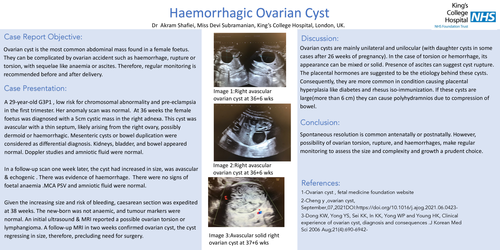
A 29-year-old G3P1, low risk for chromosomal abnormality and pre-eclampsia in the first trimester. Her anomaly scan was normal. At 36 weeks the female foetus was diagnosed with a 5cm cystic mass in the right adnexa. This cyst was avascular with a thin septum, likely arising from the right ovary, possibly dermoid or haemorrhagic. Mesenteric cysts or bowel duplication were considered as differential diagnoses. Kidneys, bladder, and bowel appeared normal. Doppler studies and amniotic fluid were normal.
In a follow-up scan one week later, the cyst had increased in size and was avascular & echogenic. There was evidence of haemorrhage. There were no signs of foetal anaemia.MCA PSV and amniotic fluid were normal.
Given the increasing size and risk of bleeding, a caesarean section was expedited at 38 weeks. The newborn was not anaemic, and tumour markers were normal. An initial ultrasound & MRI reported a possible ovarian torsion or lymphangioma. A follow-up MRI in two weeks confirmed ovarian cyst, the cyst regressing in size, therefore, precluding the need for surgery.
Discussion:
Ovarian cysts are mainly unilateral and unilocular (with daughter cysts in some cases after 26 weeks of pregnancy). In the case of torsion or haemorrhage, its appearance can be mixed or solid. The presence of ascites can suggest cyst rupture. The placental hormones are suggested to be the aetiology behind these cysts. Consequently, they are more common in conditions causing placental hyperplasias like diabetes and rhesus iso-immunization. If these cysts are large(more than 6 cm) they can cause polyhydramnios due to compression of the bowel.
Conclusion:
Spontaneous resolution is common antenatally or postnatally. However, the possibility of ovarian torsion, rupture, and haemorrhages, makes regular monitoring to assess the size and complexity and growth a prudent choice
References:
1-Ovarian cyst , fetal medicine foundation website
2-Cheng y ,ovarian cyst, September,07,2021DOI:https://doi.org/10.1016/j.ajog.2021.06.0423-
3-Dong KW, Yong YS, Sei KK, In KK, Yong WP and Young HK, Clinical experience of ovarian cyst, diagnosis and consequences .J Korean Med Sci 2006 Aug;21(4):690-6942-