1,830 posters, 67 videos, 75 audios, 29 topics, 22 sessions, 4,727 authors, 1,697 institutions
ePostersLive by SciGen Technologies S.A. All rights reserved.
RCOG World Congress 2023
June 12 - 14, 2023 | London, UK

EP.1549
Successful management of HDFN by early institution of Intrauterine transfusion programme
Poster Presenter
Authors
Affiliations
Part of Topic
Fetal Medicine
Video
Audio
SUCCESSFUL MANAGEMENT OF HDFN BY EARLY INSTITUTION OF INTRAUTERINE TRANSFUSION PROGRAMME
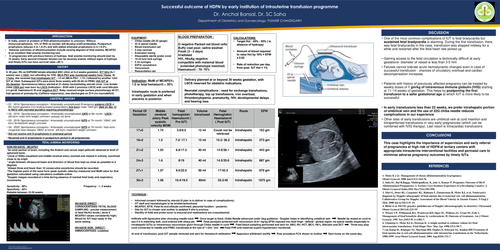
In India, extent of problem of RhD alloimmunisation is unknown. Without immunoprophylaxis, 14% of RhD-ve women will develop antiD-antibodies. Postpartum prophylaxis reduces it to 1.8-2% and with added antenatal prophylaxis to 0.1-0.2%. Adverse outcomes of alloimmunization include varying degrees of fetal anemia. MCAPSV is an excellent fetal anemia monitoring tool. In pregnancies with previous history of HDFN, fetal anemia monitoring should start from 15weeks. Early second trimester fetuses can be severely anemic without any signs of hydrops but timely IUTs can lead to survival rates >90%.
A 29 year, Rh-ve G5P0400 female attended ANC clinic at 5+4 weeks gestation. First baby, preterm, died (D12) with severe jaundice requiring phototherapy followed by 3 third trimester IUFDs (attributed to HDFN). She received only postpartum Rh-immunoglobulins. ICT titre (8+1 weeks) was 1:1024; IVIg was not affordable. MCAPSV was monitored weekly from 15wks (Plan : IUT if MoM is >1.5 / fetal hematocrit <30%). At 17wks, she received first Intrahepatic IUT (placenta : posterior) of 12ml O-ve, CMV free, leukocyte reduced, irradiated PRBC (MCAPSV was 1.74, hematocrit 9.5, fetus was O+ve, DCT 4+, EFW-270gm) followed by another 12ml IUT at 18wk. Subsequent IUTs were done three weekly with 50-65 ml PRBC (6th IUT at 30+3weeks). Spontaneous labour started at 31+6wks necessitating steroid cover. Live female child (1964 gm) was born by LSCS (Indication : BOH with 2 previous LSCS) with cord bilirubin 3.4 gm/dl, haematocrit 35 and a negative DCT. Baby received single surface phototherapy till D7, had apnoea of prematurity (Caffeine responsive), was discharged on D14 (no neurodeficit).
Early second-trimester IUTs can be technically challenging because of difficult intravascular access and risk of circulatory overload, nevertheless, drastically improves perinatal outcomes when done with expertise at tertiary centers with appropriate interventional facilities and neonatology care.