1,830 posters, 67 videos, 75 audios, 29 topics, 22 sessions, 4,727 authors, 1,697 institutions
ePostersLive by SciGen Technologies S.A. All rights reserved.
RCOG World Congress 2023
June 12 - 14, 2023 | London, UK

EP.1546
Case Report: Fetal Neuroanomaly In A Diabetic Mother with DKA
Poster Presenter
Authors
Affiliations
Part of Topic
Fetal Medicine
Case Report
A non-English speaking 32 year old Slovakian woman was diagnosed with late onset poorly controlled T1DM nine months pre-conception. Three months prior to conception she was admitted to ITU with diabetic ketoacidosis (DKA) and was noted to have a HbA1c of 116.
The HbA1c was 94 at antenatal booking. Attendance to clinic appointments was poor and she had not seen a diabetologist in pregnancy. A translator was used for all appointments.
She had a further ICU admission at 18 weeks gestation with DKA. Fetal bradycardia was noted on admission which did resolve, however the duration of which is unknown.
Abnormal neuroanatomy was suspected on routine anomaly ultrasound scan at 19 weeks.
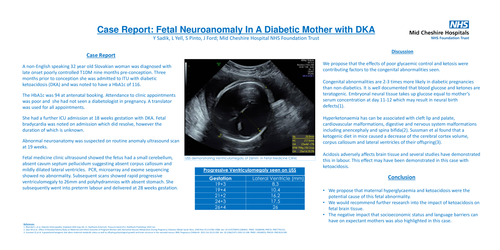
Fetal medicine clinic ultrasound showed the fetus had a small cerebellum, absent cavum septum pellucidum suggesting absent corpus callosum and mildly dilated lateral ventricles. PCR, microarray and exome sequencing showed no abnormality. Subsequent scans showed rapid progressive ventriculomegaly to 26mm and polyhydramnios with absent stomach. She subsequently went into preterm labour and delivered at 28 weeks gestation.
Discussion
We propose that the effects of poor glycaemic control and ketosis were contributing factors to the congenital abnormalities seen.
Congenital abnormalities are 2-3 times more likely in diabetic pregnancies than non-diabetics. It is well documented that blood glucose and ketones are teratogenic. Embryonal neural tissue takes up glucose equal to mother’s serum concentration at day 11-12 which may result in neural birth defects(1).
Hyperketonaemia has can be associated with cleft lip and palate, cardiovascular malformations, digestive and nervous system malformations including anencephaly and spina bifida(2). Sussman et al found that a ketogenic diet in mice caused a decrease of the cerebral cortex volume, corpus callosum and lateral ventricles of their offspring(3).
Acidosis adversely affects brain tissue and several studies have demonstrated this in labour. This effect may have been demonstrated in this case with ketoacidosis.
Conclusion
•We propose that maternal hyperglycaemia and ketoacidosis were the potential cause of this fetal abnormality.