1,830 posters, 67 videos, 75 audios, 29 topics, 22 sessions, 4,727 authors, 1,697 institutions
ePostersLive by SciGen Technologies S.A. All rights reserved.
RCOG World Congress 2023
June 12 - 14, 2023 | London, UK

EP.1542
The Medical Postnatal Patient: A Case Report Highlighting the Differential Diagnosis Process
Poster Presenter
Authors
Affiliations
Part of Topic
Maternal Medicine
Title
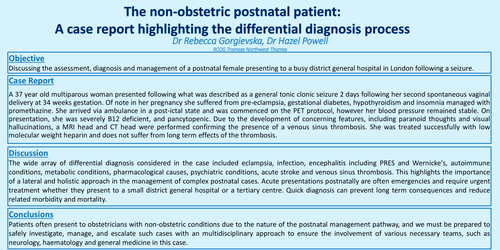
The non-obstetric postnatal patient: A case report highlighting the differential diagnosis process
Authors
Gorgievska Rebecca, Powell Hazel
Objective
Discussing the assessment, diagnosis and management of a postnatal female presenting to a busy district general hospital in London following a seizure.
Case Report
A 37 year old multiparous woman presented following what was described as a general tonic clonic seizure 2 days following her second spontaneous vaginal delivery at 34 weeks gestation. Of note in her pregnancy she suffered from pre-eclampsia, gestational diabetes, hypothyroidism and insomnia managed with promethazine. She arrived via ambulance in a post-ictal state and was commenced on the PET protocol, however her blood pressure remained stable. On presentation, she was severely B12 deficient, and pancytopenic. Due to the development of concerning features, including paranoid thoughts and visual hallucinations, a MRI head and CT head were performed confirming the presence of a venous sinus thrombosis. She was treated successfully with low molecular weight heparin and does not suffer from long term effects of the thrombosis.
Discussion
The wide array of differential diagnosis considered in the case included eclampsia, infection, encephalitis including PRES and Wernickes, autoimmune conditions, metabolic conditions, pharmacological causes, psychiatric conditions, acute stroke and venous sinus thrombosis.This highlights the importance of a lateral and holistic approach in the management of complex postnatal cases. Acute presentations postnatally are often emergencies and require urgent treatment whether they present to a small district general hospital or a tertiary centre. Quick diagnosis can prevent long term consequences and reduce related morbidity and mortality.
Conclusions
Patients often present to obstetricians with non-obstetric conditions due to the nature of the postnatal management pathway, and we must be prepared to safely investigate, manage, and escalate such cases with an multidisciplinary approach to ensure the involvement of various necessary teams, such as neurology, haematology and general medicine in this case.