1,830 posters, 67 videos, 75 audios, 29 topics, 22 sessions, 4,727 authors, 1,697 institutions
ePostersLive by SciGen Technologies S.A. All rights reserved.
RCOG World Congress 2023
June 12 - 14, 2023 | London, UK

EP.0152
Neonatal pulmonary hypertension at term following management of severe maternal coronavirus19 infection
Poster Presenter
Authors
Affiliations
Part of Topic
Pandemic and impact of Covid/Infectious Diseases
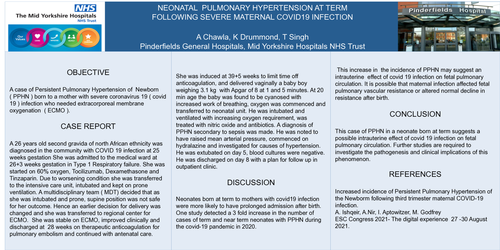
NEONATAL PULMONARY HYPERTENSION AT TERM FOLLOWING SEVERE MATERNAL COVID19 INFECTION
A Chawla, K Drummond, T Singh
Pinderfields General Hospitals, Mid Yorkshire Hospitals NHS Trust
OBJECTIVE
A case of Persistent Pulmonary Hypertension of Newborn ( PPHN ) born to a mother with severe coronavirus 19 ( covid 19 ) infection who needed extracorporeal membrane oxygenation ( ECMO ).
CASE REPORT
A 26 years old second gravida of north African ethnicity was diagnosed in the community with COVID 19 infection at 25 weeks gestation She was admitted to the medical ward at 26+3 weeks gestation in Type 1 Respiratory failure. She was started on 60% oxygen, Tocilizumab, Dexamethasone and Tinzaparin. Due to worsening condition she was transferred to the intensive care unit, intubated and kept on prone ventilation. A multidisciplinary team ( MDT) decided that as she was intubated and prone, supine position was not safe for her outcome. Hence an earlier decision for delivery was changed and she was transferred to regional center for ECMO. She was stable on ECMO, improved clinically and discharged at 28 weeks on therapeutic anticoagulation for pulmonary embolism and continued with antenatal care. She was induced at 39+5 weeks to limit time off anticoagulation, and delivered vaginally a baby boy weighing 3.1 kg with Apgar of 8 at 1 and 5 minutes. At 20 min age the baby was found to be cyanosed with increased work of breathing, oxygen was commenced and transferred to neonatal unit. He was intubated and ventilated with increasing oxygen requirement, was treated with nitric oxide and antibiotics. A diagnosis of PPHN secondary to sepsis was made. He was noted to have raised mean arterial pressure, commenced on hydralazine and investigated for causes of hypertension. He was extubated on day 5, blood cultures were negative. He was discharged on day 8 with a plan for follow up in outpatient clinic.
DISCUSSION
Neonates born at term to mothers with covid19 infection were more likely to have prolonged admission after birth. One study detected a 3 fold increase in the number of cases of term and near term neonates with PPHN during the covid-19 pandemic in 2020.This increase in the incidence of PPHN may suggest an intrauterine effect of covid 19 infection on fetal pulmonary circulation. It is possible that maternal infection affected fetal pulmonary vascular resistance or altered normal decline in resistance after birth.
CONCLUSION
This case of PPHN in a neonate born at term suggests a possible intrauterine effect of covid 19 infection on fetal pulmonary circulation. Further studies are required to investigate the pathogenesis and clinical implications of this phenomenon.
REFERENCES
Increased incidence of Persistent Pulmonary Hypertension of the Newborm following third trimester maternal COVID-19 infection. A. Ishqeir, A.Nir, I. Aptowitzer, M. Godfrey. ESC Congress 2021- The digital experience 27 -30 August 2021.