1,830 posters, 67 videos, 75 audios, 29 topics, 22 sessions, 4,727 authors, 1,697 institutions
ePostersLive by SciGen Technologies S.A. All rights reserved.
RCOG World Congress 2023
June 12 - 14, 2023 | London, UK

EP.1521
ASSOCIATION OF SKIN SCAR CHARACTERISTICS WITH INTRA-ABDOMINAL ADHESIONS DURING REPEAT CAESAREAN SECTION
Poster Presenter
Authors
Affiliations
Part of Topic
High Risk Pregnancy
Video
ASSOCIATION OF SKIN SCAR CHARACTERISTICS WITH INTRA-ABDOMINAL ADHESIONS DURING REPEAT CAESAREAN SECTION
Vignesh Durai , Gowri Dorairajan
Jawaharlal Institute of Postgraduate Medical Education and Research (JIPMER), Puducherry, India
Introduction:
Caesarean section rates are on the rise, and repeat caesarean is the second most common indication. Abdominal scar characteristics might indicate the severity of adhesions due to biological similarities between these healing processes. It can be used as a screening tool in preoperative assessment & proper planning can be done to overcome the difficulties.
Aim &objective:
Predicting severe intra-abdominal adhesions and weak uterine scar based on the morphology of skin scar at term repeat caesarean.
Study design:
Diagnostic accuracy study.
Methodology:
Inclusion criteria: Pregnant women with previous one caesarean section undergoing repeat caesarean at term.
Exclusion criteria: H/o classical caesarean & previous surgeries, immunosuppressed state, placenta previa, endometriosis.
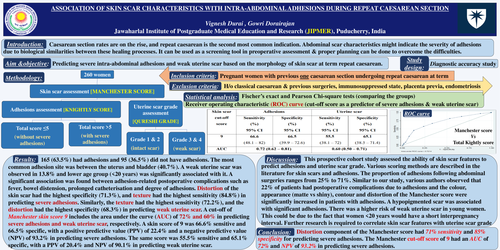
Two hundred sixty women with previous one caesarean undergoing repeat caesarean at term were included. Preoperatively the external scar was assessed by Manchester score. Intraoperatively, Knightly score was used for adhesions at five different sites. The total adhesion score was categorised into a score ≤5 and a score >5 (severe adhesions). The uterine scar was graded by Qureshi’s system and grouped into women with intact scar (grades 1 and 2) and weak scar (grades 3 and 4).
Statistical analysis: Fischer’s exact and Pearson Chi-square tests (comparing the groups). Receiver operating characteristic (ROC) curve (cut-off score as a predictor of severe adhesions & weak uterine scar).
Results:
165 (63.5%) had adhesions and 95 (36.5%) did not have adhesions. The most common adhesion site was between the uterus and bladder (40.7%). A weak uterine scar was observed in 13.8% and lower age group (<20 years) was significantly associated with it. A significant association was found between adhesion-related postoperative complications such as fever, bowel distension, prolonged catheterisation and degree of adhesions. Distortion of the skin scar had the highest specificity (71.3%), and texture had the highest sensitivity (84.8%) in predicting severe adhesions. Similarly, the texture had the highest sensitivity (72.2%), and the distortion had the highest specificity (68.3%) in predicting weak uterine scar. A cut-off of Manchester skin score 9 includes the area under the curve (AUC) of 72% and 60% in predicting severe adhesions and weak uterine scar, respectively. A skin score of 9 was 66.6% sensitive and 66.5% specific, with a positive predictive value (PPV) of 22.4% and a negative predictive value (NPV) of 93.2% in predicting severe adhesions. The same score was 55.5% sensitive and 65.1% specific, with a PPV of 20.4% and NPV of 90.1% in predicting weak uterine scar.
Discussion:
This prospective cohort study assessed the ability of skin scar features to predict adhesions and uterine scar grade. Various scoring methods are described in the literature for skin scars and adhesions. The proportion of adhesions following abdominal surgeries ranges from 25% to 71%. Similar to our study, various authors observed that 22% of patients had postoperative complications due to adhesions and the colour, appearance (matte vs shiny), contour and distortion of the Manchester score were significantly increased in patients with adhesions. A hypopigmented scar was associated with significant adhesions. There was a higher risk of weak uterine scar in young women. This could be due to the fact that women <20 years would have a short interpregnancy interval. Further research is required to correlate skin scar features with uterine scar grade.
Conclusion:
Distortion component of the Manchester score had 71% sensitivity and 85% specificity for predicting severe adhesions. The Manchester cut-off score of 9 had an AUC of 72% and NPV of 93.2% in predicting severe adhesions.