1,830 posters, 67 videos, 75 audios, 29 topics, 22 sessions, 4,727 authors, 1,697 institutions
ePostersLive by SciGen Technologies S.A. All rights reserved.
RCOG World Congress 2023
June 12 - 14, 2023 | London, UK

EP.1520
Postoperative vaginal cleaning and reduction in the rate of endometritis wound infection
Poster Presenter
Authors
Affiliations
Hamdard University Hospital Karachi, Dow University Ojha campus
Part of Topic
Labour Ward Management
Audio
Postoperative vaginal cleaning and reduction in the rate of endometritis wound infection
Objective: Caesarean section is a common obstetric procedure but is associated with major risks. Several guidelines have been established, including preoperative vaginal cleaning and antibiotic prophylaxis. However, complications are still a concern. Vaginal cleaning is performed preoperatively, most commonly with povidone. It is known to lower the risk of infection; however, complications are still a concern. The objective of this study is to see whether postoperative vaginal cleaning with povidone solution helps reduce complications.
Design: This was a comparative single-center study done on pregnant women undergoing caesarean section, with patients being followed up after 2 and 6 weeks. Vaginal cleaning was done with 10% povidone solution postoperatively.
Method: The patients were divided into two groups: Group 1, where vaginal cleaning was done, and Group 2, where no vaginal cleaning was done. Rates of endometritis, wound infection, fever, and duration of hospital stay were compared. Chi-Square Test and descriptive statistics were used to compare the results.
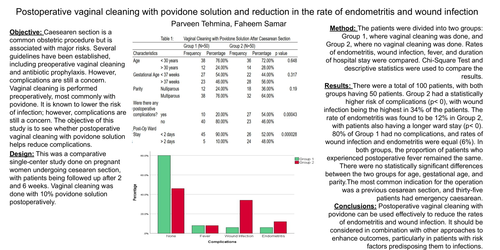
Results: There were a total of 100 patients, with both groups having 50 patients. Group 2 had a statistically higher risk of complications (p< 0), with wound infection being the highest in 34% of the patients. The rate of endometritis was found to be 12% in Group 2, with patients also having a longer ward stay (p< 0). 80% of Group 1 had no complications, and rates of wound infection and endometritis were equal (6%). In both groups, the proportion of patients who experienced postoperative fever remained the same. There were no statistically significant differences between the two groups for age, gestational age, and parity. The most common indication for the operation was a previous cesarean section, and thirty-five patients had an emergency caesarean.
Conclusions: Postoperative vaginal cleaning with povidone can be used effectively to reduce the rates of endometritis and wound infection. It should be considered in combination with other approaches to enhance outcomes, particularly in patients with risk factors predisposing them to infections.