1,830 posters, 67 videos, 75 audios, 29 topics, 22 sessions, 4,727 authors, 1,697 institutions
ePostersLive by SciGen Technologies S.A. All rights reserved.
RCOG World Congress 2023
June 12 - 14, 2023 | London, UK

EP.1511
An unusual complication of Copper T-intrauterine device: A case report
Poster Presenter
Authors
Affiliations
Part of Topic
Benign Gynaecology
An unusual complication of Copper-T intrauterine device: a case reoprt
Objectives
To highlight the importance of checking for completeness of the intrauterine devices at the time of removal.
Case report
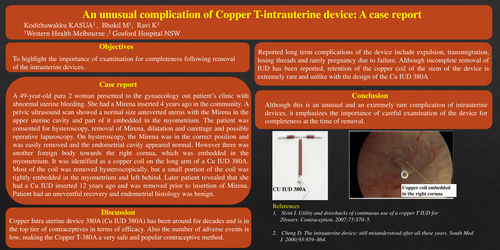
A 49-year-old para 2 woman presented to the gynaecology outpatient’s clinic with abnormal uterine bleeding. She had a Mirena inserted 4 years ago in the community. A pelvic ultrasound scan showed a normal size anteverted uterus with the Mirena in the upper uterine cavity and part of it embedded in the myometrium. The patient was consented for hysteroscopy, removal of Mirena, dilatation and curettage and possible operative laparoscopy. On hysteroscopy, the Mirena was in the correct position and was easily removed and the endometrial cavity appeared normal. However, there was another foreign body towards the right cornua, which was embedded in the myometrium. It was identified as a copper coil on the long arm of a Cu IUD 380A. Most of the coil was removed hysteroscopically, but a small portion of the coil was tightly embedded in the myometrium and left behind. Later patient revealed that she had a Cu IUD inserted 12 years ago and was removed prior to insertion of Mirena. Patient had an uneventful recovery and endometrial histology was benign.
Discussion
Copper Intra uterine device 380A (Cu IUD 380A) has been around for decades and is in the top tier of contraceptives in terms of efficacy. Also, the number of adverse events is low, making the Copper T-380A a very safe and popular contraceptive method. Reported long term complications of the device include expulsion, transmigration, losing threads and rarely pregnancy due to failure. Although incomplete removal of IUD has been reported, retention of the copper coil of the stem of the device is extremely rare and unlike with the design of the Cu IUD 380A.
Conclusion
Although this is an unusual and an extremely rare complication of intrauterine devices, it emphasises the importance of careful examination of the device for completeness at the time of removal.