1,830 posters, 67 videos, 75 audios, 29 topics, 22 sessions, 4,727 authors, 1,697 institutions
ePostersLive by SciGen Technologies S.A. All rights reserved.
RCOG World Congress 2023
June 12 - 14, 2023 | London, UK

EP.1496
Improving Obstetrics and Gynaecology Foundation/GP junior doctor departmental induction using simulation
Poster Presenter
Authors
Daniel Herridge, Wuraola Obadahun, Rania El Matary, Anahit Zakaryan
Affiliations
Part of Topic
Simulation and Training
Improving Obstetrics & Gynaecology Foundation and GP Junior Doctor Departmental Induction Using Simulation-based Education (SBE)
Mr Daniel Herridge, Dr WuraolaObadahun, Dr Rania El Matary, Ms Anahit Zakaryan, Dartford and Gravesham NHS Trust
OBJECTIVES AND AIMS
It is well established that non-specialty training junior doctors (Foundation trainees/GP trainees) can struggle with frequent transitions into new departments, particularly in O&G where workload is busy and clinical management unfamiliar. There is evidence that simulation-based education improves competence and confidence and is widely used in teaching for the management of Obstetric emergencies.
The aim of this study was to improve the confidence of new doctors beginning their O&G clinical rotation in our department by increasing their knowledge-base of common presentations, protocols, and procedures through designing and implementing a trainee-focused simulation-based training programme into their induction.
METHOD
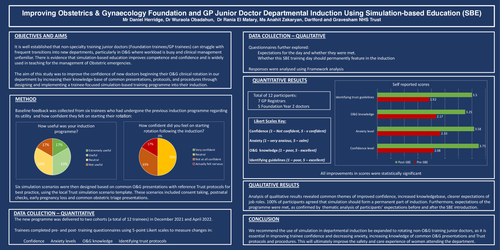
Baseline feedback was collected from six trainees who had undergone the previous induction programme regarding its utility and how confident they felt on starting their rotation:
Six simulation scenarios were then designed based on common O&G presentations with reference Trust protocols for best practice, using the local Trust simulation scenario template. These scenarios included consent taking, postnatal checks, early pregnancy loss and common obstetric triage presentations.
DATA COLLECTION – QUANTITATIVE
The new programme was delivered to two cohorts (a total of 12 trainees) in December 2021 and April 2022.
Trainees completed pre- and post- training questionnaires using 5-point Likert scales to measure changes in:
Confidence Anxiety levels O&G knowledge Identifying trust protocols
DATA COLLECTION – QUALITATIVE
Questionnaires further explored:
Expectations for the day and whether they were met.
Whether this SBE training day should permanently feature in the induction
Responses were analysed using Framework analysis
QUALITATIVE RESULTS
Analysis of qualitative results revealed common themes of improved confidence, increased knowledgebase, clearer expectations of job roles. 100% of participants agreed that simulation should form a permanent part of induction. Furthermore, expectations of the programme were met, as confirmed by thematic analysis of participants’ expectations before and after the SBE introduction.
CONCLUSION
We recommend the use of simulation in departmental induction be expanded to rotating non-O&G training junior doctors, as it is essential in improving trainee confidence and decreasing anxiety, increasing knowledge of common O&G presentations and Trust protocols and procedures. This will ultimately improve the safety and care experience of women attending the department.