1,830 posters, 67 videos, 75 audios, 29 topics, 22 sessions, 4,727 authors, 1,697 institutions
ePostersLive by SciGen Technologies S.A. All rights reserved.
RCOG World Congress 2023
June 12 - 14, 2023 | London, UK

EP.0639
Non-technical skills for managing impacted fetal head: a qualitative, simulation study (DiSIMpact)
Poster Presenter
Part of Topic
Simulation and Training
Title
Non-technical skills for managing impacted fetal head: a qualitative, simulation study (DiSIMpact)
Objective
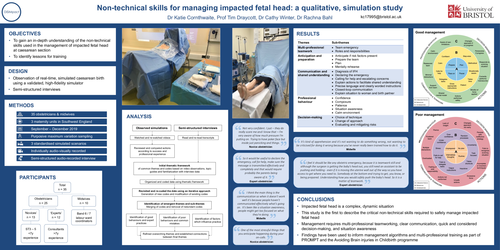
To gain an in-depth understanding of the non-technical skills used in the management of impacted fetal head (IFH) at caesarean section (CS) and identify lessons for training.
Design
Semi-structured interviews and observation of real-time, simulated caesarean birth using a validated, high-fidelity simulator.
Method
Setting:
Three maternity units in Southwest England
Participants:
- Expert obstetricians (consultants with expertise in complex CS) (n=12)
- Novice obstetricians (ST3+ with <7 years' experience) (n=13)
- Senior labour ward midwives (n=10)
Sampling:
Purposive maximum variation sampling according to years of experience. Sample size determined by data saturation.
Recruitment:
September - December 2019
Data collection:
Participants audio-visually recorded undertaking three standardised simulated scenarios of IFH at CS.Participants asked to proceed as in real-life, verbalising thought processes and actions (think aloud). Obstetricians asked to deliver the fetal head and midwives, to perform a vaginal push-up.
Simulations followed by an audio-recorded semi-structured interview.
Analysis:
Videos were analysed to identify common themes. Anonymised interview recordings were transcribed verbatim, and coded using an initial thematic framework, based on video observations, topic guides and interview data. A second investigator individually analysed and coded a subset of recordings and transcripts. Data were revisited, re-coded and triangulated using an iterative, reflexive approach, and thematic analysis used to identify salient themes.
Results
Analysis highlighted the importance of non-technical skills in the management of IFH. The following themes and sub-themes were identified:
1) Multi-professional teamwork
a) team emergency
b) roles and responsibilities
2) Anticipation and preparation
a) anticipate if risk factors present
b) prepare the team
c) plan
d) mentally rehearse
3) Communication and shared understanding
a) diagnosis of IFH
b) declaring the emergency
c) calling for help and escalating concerns
d) explain actions to facilitate shared understanding
e) precise language and clearly worded instructions
f) closed-loop communication
g) explain situation to woman and birth partner
4) Professional behaviour
a) confidence
b) composure
c) patience
d) situation awareness
e) calm environment
5) Decision-making
a) choice of technique
b) change of approach
c) evaluating and mitigating risks
Expert practices and common errors were identified for each theme.
Conclusions
IFH is a complex, dynamic situation that requires multi-professional teamworking, clear communication, quick and considered decision-making and situation awareness. This study is the first to describe the critical non-technical skills required to safely manage IFH. Findings have been used to inform management algorithms and multi-professional training as part of PROMPT and the Avoiding Brain injuries in Childbirth programme.