1,830 posters, 67 videos, 75 audios, 29 topics, 22 sessions, 4,727 authors, 1,697 institutions
ePostersLive by SciGen Technologies S.A. All rights reserved.
RCOG World Congress 2023
June 12 - 14, 2023 | London, UK

EP.0148
Immunogenicity and outcomes after maternal COVID-19 vaccination in a Philippine tertiary hospital
Part of Topic
Pandemic and impact of Covid/Infectious Diseases
Immunogenicity and outcomes after maternal COVID-19 vaccination in a Philippine tertiary hospital
Authors: Elva Marita Pena Sarte, MD, MBA1; David Jerome P. Ong, MD, MBA2; Elizabeth Y. Arcellana-Nuqui, MD, FPSP, FCAP2; Irene B. Quinio MD, MBA, FPOGS, FPSMFM, FPSUOG1
1Institute for Women’s Health, The Medical City; 2Department of Laboratory Medicine and Pathology, The Medical City
Objective: The study aimed to describe and compare neonatal antibody response following COVID-19 vaccination in patients with or without history of COVID-19 infection during pregnancy. Comparison between the two groups was also done in terms of maternal outcomes, neonatal outcomes, timing of vaccination, and type of vaccine.
Design: There is limited data concerning COVID-19 immunogenicity of pregnant patients and their neonates. This was a pilot prospective cohort study on patients who delivered in a Philippine tertiary hospital from February 1 to July 31, 2022.
Methodology: The study was conducted on 144 obstetric patients aged 18-45. Study participants were divided into (1) vaccinated-only and (2) vaccinated with history of COVID-19 infection during pregnancy. Maternal blood samples were taken on admission while neonatal cord blood was collected post-partum. A quantitative chemiluminescent immunoassay (VITROS® Anti-SARS-CoV-2 IgG Quantitative Test by Ortho-Clinical Diagnostics, Inc.) was used to detect SARS-CoV-2 IgG.
Results: All maternal antibody levels yielded presence of significant antibodies. Antibody levels were measured in 89 neonates in the vaccinated-only group and 55 neonates in the vaccinated with history of COVID-19 infection, with 99.3 % and 100% of samples yielding positive antibodies respectively. Every unit increase in maternal IgG had a 0.75 unit increase in neonatal IgG (r=0.75; 95% CI 0.62–0.88; p<0.001). There was no statistical difference in neonatal antibody response in those who were vaccinated-only and those who were vaccinated and contracted COVID-19 during pregnancy (p value=0.576). There was no difference in maternal and neonatal outcomes between the two groups.
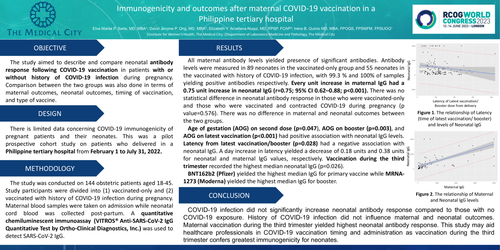
Age of gestation (AOG) on second dose (p=0.047), AOG on booster (p=0.003), and AOG on latest vaccination (p<0.001) had positive association with neonatal IgG levels. Latency from latest vaccination/booster (p=0.028) had a negative association with neonatal IgG. A day increase in latency yielded a decrease of 0.18 units and 0.38 units for neonatal and maternal IgG values, respectively. Vaccination during the third trimester recorded the highest median neonatal IgG (p=0.026).
BNT162b2 (Pfizer) yielded the highest median IgG for primary vaccine while MRNA-1273 (Moderna) yielded the highest median IgG for booster.
Conclusion: COVID-19 infection did not significantly increase neonatal antibody response compared to those with no COVID-19 exposure. History of COVID-19 infection did not influence maternal and neonatal outcomes. Maternal vaccination during the third trimester yielded highest neonatal antibody response. This study may aid healthcare professionals in COVID-19 vaccination timing and administration as vaccination during the third trimester confers greatest immunogenicity for neonates.