1,830 posters, 67 videos, 75 audios, 29 topics, 22 sessions, 4,727 authors, 1,697 institutions
ePostersLive by SciGen Technologies S.A. All rights reserved.
RCOG World Congress 2023
June 12 - 14, 2023 | London, UK

EP.1492
Induction of labor (IOL)with Propess and its Outcome in Dubai Hospital
Poster Presenter
Authors
Affiliations
Part of Topic
Labour Ward Management
Objectives:
To identify number of patients who had successful Induction of labor using PROPESS.
To identify number of patients who had successful vaginal delivery using PROPESS.
To identify number of patients taken for emergency caesarian section after PROPESS.
To identify number of patients had side effects due to PROPESS.
Design & Method:
prospective study done over 6 months period, as an audit and reaudit.
Study period: 6 months
Inclusion criteria:
All patients posted for IOL using PROPESS as method of IOL.
Data collection:
Prospectively data collection with audit tool form including bishop score, indication for IOL, progress of the patients, CTG abnormality, mode of delivery, interval from start of IOL till delivery, and the postpartum complications.
Results:
Total number of women who underwent IOL with Propess were 93.
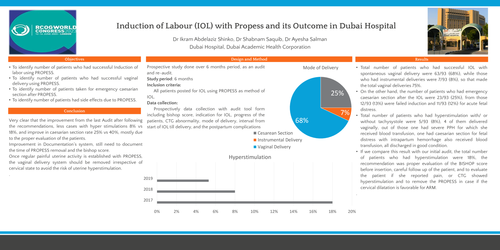
Total number of patients who had successful IOL with spontaneous vaginal delivery were 63/93 (68%), while those who had instrumental deliveries were 7/93 (8%), so that made the total vaginal deliveries 75%.
On the other hand, the number of patients who had emergency caesarian section after the IOL were 23/93 (25%), from those 12/93 (13%) were failed induction and 11/93 (12%) for acute fetal distress.
Total number of patients who had hyperstimulation with/ or without tachysystole were 5/93 (8%), 4 of them delivered vaginally, out of those one had severe PPH for which she received blood transfusion, one had caesarian section for fetal distress with intrapartum hemorrhage also received blood transfusion, all discharged in good condition.
Of we compare this result with our initial audit, the total number of patients who had hyperstimulation were 18%, the recommendation was proper evaluation of the BISHOP score before insertion, careful follow up of the patient, and to evaluate the patient if she reported pain, or CTG showed hyperstimulation and to remove the Propess in case if the cervical dilation is favorable for ARM.
Conclusions:
Very clear that the improvement from the last Audit after following the recommendations, less cases with hyper stimulations 8% vs 18%, and improve in caesarian section rate 25% vs 40%, mostly due to proper evaluation of the patients.
Improvement in Documentations system, still need to document the time of PROPESS removal and the bishop score.
Once regular painful uterine activity is established with PROPESS, the vaginal delivery system should be removed irrespective of cervical state to avoid the risk of uterine hyperstimulation.