1,830 posters, 67 videos, 75 audios, 29 topics, 22 sessions, 4,727 authors, 1,697 institutions
ePostersLive by SciGen Technologies S.A. All rights reserved.
RCOG World Congress 2023
June 12 - 14, 2023 | London, UK

EP.1489
IS EARLY ORAL FEEDING AFTER CAESAREAN SECTION BENEFICIAL IN LOW-RESOURCE SETTING?
Poster Presenter
Part of Topic
Labour Ward Management
IS EARLY ORAL FEEDING AFTER CAESAREAN SECTION BENEFICIAL IN LOW-RESOURCE SETTING?
Babatunde Awolaja1, Taofik Ogunfunmilayo2, David Awonuga2, Adesoji Adebayo2
1Macclesfield District General Hospital, Macclesfield, United Kingdom. 2Federal Medical Centre, Abeokuta, Nigeria.
Objective: To evaluate the safety and benefits of early initiation of oral feeding after caesarean section.
Design: A prospective randomised controlled study
Methodology: The study was carried out at the postnatal ward of the Department of Obstetrics and Gynaecology, Federal Medical Centre, Abeokuta.
A total of 236 women who met the inclusion criteria were assessed and randomised into two groups: early oral feeding group and the routine feeding group.
Women in the early oral feeding group were given sips of water 6 – 8 hours after caesarean section followed by oral feeding of pap (a locally made corn porridge) 100ml within 12 hours. Women in the routine feeding group were restricted from oral fluid intake for 24 hours and then given sips of water on the 1st postoperative day after listening to bowel sound. The outcome measures were the incidence of paralytic ileus in both groups, duration of intravenous hydration, time to passage of flatus and bowel evacuation, postoperative febrile morbidity, and maternal satisfaction. Randomisation was achieved by a computer-generated random number list; data collection was done using a semi structured pretested questionnaire and analysis was done using SPSS version 19.
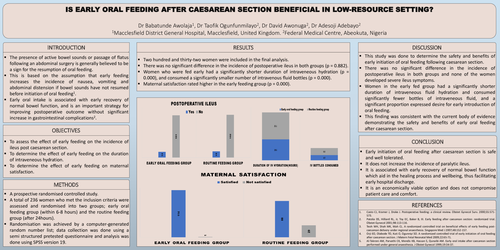
Results: Two hundred and thirty-two women were included in the final analysis. There was no significant difference in the incidence of postoperative ileus in both groups (p = 0.882). Women who were fed early had a shorter mean postoperative time interval to passage of flatus (p = 0.007), and a shorter duration of intravenous hydration (p = 0.000). Maternal satisfaction also rated higher in the early feeding group (p = 0.000)
Conclusion: Early initiation of oral feeding post caesarean section is safe and well tolerated without increasing the incidence of paralytic ileus. It is associated with early recovery of normal bowel function which aid in the healing process and general wellbeing thus improving the postoperative outcome and facilitates early hospital discharge. It is an economically viable option, and it does not compromise patient care and comfort. Hence, the practice should be adopted to improve obstetric care in low-resource setting.