1,830 posters, 67 videos, 75 audios, 29 topics, 22 sessions, 4,727 authors, 1,697 institutions
ePostersLive by SciGen Technologies S.A. All rights reserved.
RCOG World Congress 2023
June 12 - 14, 2023 | London, UK

EP.1484
Auditing the positive predictive colposcopic assessment and the effectiveness of LLETZ procedure
Poster Presenter
Part of Topic
Gynae Oncology
Title:
Auditing the positive predictive colposcopic assessment and the effectiveness of LLETZ procedure
Authors:
Jordan Isgin, Paul Carter
1) Introduction
Cervical screening is an effective way to diagnose and treat cervical intraepithelial neoplasia (CIN) with estimates that over 2000 lives are saved each year in the UK.
However, the subjective nature of colposcopy has remained controversial, with concerns related to the misinterpretation of cervical epithelial changes and overlooking of invasive disease and glandular abnormalities, especially when implemented in the context of trust-specific ‘see and treat policies’, despite national guidance found in document 20.
This study assessed the local management and outcomes in women treated with a large loop excision of the transformation zone (LLETZ) compared to national expected outcomes. We compared the colposcopic diagnosis with the cytology, and the histology of the LLETZ-biopsy. We also compared disease severity to excision depth and patient smoker status.
2) Aims
In women who had disease reported at the endocervical margin:
1) What percentage had a complete (adequate) colposcopy compared to an incomplete (inadequate) colposcopy?
2) What percentage required further management post-LLETZ, for ongoing high-grade disease? How did this compare with national expected targets?
3) How did the histology of the LLETZ-biopsy compare against the referral smear and the colposcopic assessment?
3) Methods
A retrospective, internal clinical audit was performed on women who had disease reported at the endocervical junction and had undergone a LLETZ procedure over a 24-month period between May 2020 and June 2022.
A list was compiled using the ViewPoint database located on terminals within the gynaecological outpatient department of St. George’s Hospital. Previous smear tests were obtained on the OpenExeter database and completed test of cure (TOC) cytology results were obtained on the NHS database eView.
Cytology results from primary care smears were categorised into negative, low-grade or high-grade dyskaryosis. Colposcopic assessment was categorised into negative, low-grade or high-grade disease. While histopathology results were categorised into negative, low-grade (CIN 1) or high-grade (CIN 2 or CIN 3) dysplasia. Following the 6-month TOC, patients were categorised into ‘discharged’, ‘repeat colposcopy’ or ‘repeat 2nd LLETZ’.
Initial exclusions included patients where no TOC was reported and in cases where a cancer diagnosis was made, and those patients were referred to oncology.
4) Results
Over a 24-month period, 108 women were identified who underwent a LLETZ procedure following abnormal smear cytology and the presence of high-risk HPV. Overall, the median age was 32yrs (M=34.6y, SD=9.0y, Range= 24-68y) and 8% of the cohort were aged 50y or older. The median biopsy depth was 10mm (M=10.6mm, SD=3.8mm, Range=4-24mm) and 15% of biopsies had a depth of excision greater than 15mm. Out of these 108 women, a post-LLETZ TOC smear 6 months later was available for 86 of them (80% of the cohort).
A complete colposcopy was recorded for 94% of patients, while an incomplete colposcopy was identified in 6% of patients. The referral smears from these 108 women were as follows: 4% low-grade cytology (borderline, mild), 92% high-grade cytology (moderate, severe and glandular) and 4% cancer.
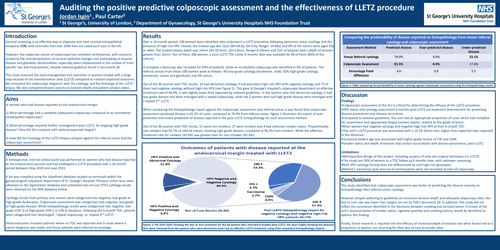
Out of the 86 women with TOC results, 10 had abnormal cytology, 3 had persistent high-risk HPV with negative cytology and 73 of them had negative cytology without high-risk HPV (see Figure 1). This gave St George’s Hospital’s colposcopy department an effective treatment rate of 84.9%, a rate slightly lower than expected by national guidelines. In the women who had abnormal cytology, 5 had low-grade disease and were managed with a repeat colposcopy, while the 5 women who had high-grade disease were managed with a repeat 2nd LLETZ.
When comparing the histopathology report against the colposcopic assessment and referral smear, it was found that colposcopic assessment predicted disease in 81.5% of cases, compared to 76.9% from referral smear. Figure 2 illustrates the extent of over-prediction and under-prediction of disease reported in the post-LLETZ histopathology for each assessment method.
Out of the 86 women with TOC results, 55 were non-smokers, 27 were smokers and 4 had unknown smoker status. Proportionally, non-smokers had 92.7% of referral smears showing high-grade disease, compared to 96.3% from smokers. While the effective treatment rate for smokers (92.6%) was greater than for non-smokers (81.8%).
5) Discussion
Findings
•Colposcopic assessment of the SCJ is critical for determining the efficacy of the LLETZ procedure.
•HPV status and cytology assessment 6 months post-LLETZ are important determinants for predicting disease persistence and disease recurrence.
•Compared to national guidelines, this unit had an appropriate proportion of cases which had complete SCJ assessment and appropriate biopsy excision depths, relative to the grade of lesion.
•Most women had negative cytology and negative high-risk HPV at their 6-month TOC.
•The unit’s LLETZ procedure was associated with a 14.1% failure rate, higher than expected rates reported in the literature.
•Increased patient age was associated with higher grade lesions of CIN and CGIN.
•Smoker status and depth of excision had unclear associations with disease persistence, post-LLETZ.
Limitations
•Retrospective design of this project, including analysis of only one surgical technique (i.e LLETZ).
•The study lost 20% of women to a TOC follow up 6 months later, with unknown reasoning.
•NHS HPV cytology testing does not differentiate by viral high-risk genotypes.
•Patient’s menstrual cycle and use of contraception were not recorded at time of colposcopy.
6) Conclusions
This study identified that colposcopic assessment was better at predicting the disease severity on histopathology than referral smear cytology.
However, despite adhering to guidelines on minimum excision depth and adequate colposcopy rates, the test of cure rate was lower than targets set out by PHE’s document 20. In addition, this study did not reflect the correlation identified in the literature between smoking and cervical cancer. A review of the unit’s documentation of smoker status, cigarette quantity and smoking history, would be beneficial to address this finding.
Finally, future research is required into the efficacy of increased depth of excision and what factors led to a proportion of women not returning for their test of cure 6-months later.