1,830 posters, 67 videos, 75 audios, 29 topics, 22 sessions, 4,727 authors, 1,697 institutions
ePostersLive by SciGen Technologies S.A. All rights reserved.
RCOG World Congress 2023
June 12 - 14, 2023 | London, UK

EP.1480
CLINICOCYTOLOGICAL ANALYSIS OF PAP SMEARS AT FEDERAL MEDICAL CENTRE ABEOKUTA, NIGERIA.
Poster Presenter
Authors
Affiliations
Part of Topic
Gynae Oncology
CLINICOCYTOLOGICAL ANALYSIS OF PAP SMEARS AT FEDERAL MEDICAL CENTRE ABEOKUTA, NIGERIA
1. Oluwabusuyi Adebiyi 2. Adewale Alayo
Department of Obstetrics and Gynaecology Federal Medical Centre Abeokuta, Ogun State. Nigeria.
INTRODUCTION
Cervical Pap smear is a relatively simple, cost effective screening test involving examination of the cells of the exfoliative epithelium of the squamo-columnar junction of the cervix to detect abnormalities that are precursor of cervical cancer.
OBJECTIVES
To determine the sociodemographic features and cytological pattern of conventional cervical pap smear testing amongst women attending the colposcopy unit at the Federal Medical Centre, Abeokuta (FMCA).
METHODS
This was a retrospective study, records from the colposcopy unit and department of morbid anatomy and histopathology were retrieved for all women who had cervical Pap smear testing during the period between January 2019 to December 2021.
Relevant data were extracted using a standardized proforma that was designed based on the study objectives. The data collected included age, parity, occupation, clinical presentation and cytological diagnosis.
Statistical analysis was done using SPSS statistical software version 25.0.
RESULTS
A total of 1032 cervical pap smear testing were performed by the service during the study period. Thirty (30) cytology reports were missing and 78 were unsatisfactory for evaluation and therefore were not included in the study.
924 cervical pap smear screening were analysed. The modal age of those screened was 40 years.
320(34.6%) were routine cervical cancer screening, out of which 15(4.69%) were repeat screening.
The remaining 604(65.4%) were opportunistic screening for women who presented with various clinical entities including abnormal uterine bleeding (30.9%), infertility (26.3%) and abnormal vagina discharge (8.2%).
Majority of the cervical pap smear, 665 (72%) were Negative for intraepithelial lesion and malignancy (NILM) and 237(25.6%) showed inflammatory changes.
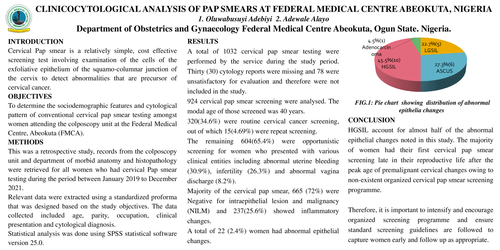
A total of 22 (2.4%) women had abnormal epithelial changes.
CONCLUSION
HGSIL account for almost half of the abnormal epithelial changes noted in this study. The majority of women had their first cervical pap smear screening late in their reproductive life after the peak age of premalignant cervical changes owing to non-existent organized cervical pap smear screening programme.
Therefore, it is important to intensify and encourage organized screening programme and ensure standard screening guidelines are followed to capture women early and follow up as appropriate.