1,830 posters, 67 videos, 75 audios, 29 topics, 22 sessions, 4,727 authors, 1,697 institutions
ePostersLive by SciGen Technologies S.A. All rights reserved.
RCOG World Congress 2023
June 12 - 14, 2023 | London, UK

EP.1478
Prognostic factors for breast cancer in younger women
Poster Presenter
Part of Topic
Gynae Oncology
Prognostic factors for breast cancer in younger women
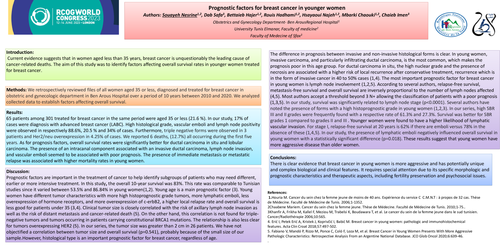
Objective: Current evidence suggests that in women aged less than 35 years, breast cancer is unquestionably the leading cause of cancer-related deaths. The aim of this study was to identify factors affecting overall survival rates in younger women treated for breast cancer.
Design: Retrospective monocentric descriptive and analytic study.
Method: We retrospectively reviewed files of all women aged 35 or less, diagnosed and treated for breast cancer in obstetric and gynecologic department in Ben Arous Hospital over a period of 10 years between 2010 and 2020. We analyzed collected data to establish factors affecting overall survival.
Result: 65 patients among 301 treated for breast cancer in the same period were aged 35 or less (21.6 %). In our study, 17% of cases were diagnosis with advanced breast cancer (LABC). High histological grade, vascular emboli and lymph node positivity were observed in respectively 88.6%, 20.5 % and 34% of cases. Furthermore, triple negative forms were observed in 3 patients and Her2/neu overexpression in 4.25% of cases. We reported 6 deaths, (12.7%) all occurring during the first five years. As for prognosis factors, overall survival rates were significantly better for ductal carcinoma in situ and lobular carcinoma. The presence of an intracanal component associated with an invasive ductal carcinoma, lymph node invasion, and vascular emboli seemed to be associated with poor prognosis. The presence of immediate metastasis or metastatic relapse was associated with higher mortality rates in young women.
Conclusion: There is clear evidence that breast cancer in young women is more aggressive and has potentially unique and complex biological and clinical features. It requires special attention due to its specific morphologic and prognostic characteristics and therapeutic aspects, including fertility preservation and psychosocial issues.