1,830 posters, 67 videos, 75 audios, 29 topics, 22 sessions, 4,727 authors, 1,697 institutions
ePostersLive by SciGen Technologies S.A. All rights reserved.
RCOG World Congress 2023
June 12 - 14, 2023 | London, UK

EP.1475
The Evaluation of Management of Endometrial Hyperplasia (EH) with and without Atypia.
Poster Presenter
Authors
Affiliations
Part of Topic
Gynae Oncology
TITLE : The Evaluation of Management of women with Endometrial Hyperplasia (EH) with and without Atypia.
Tahira Rashid , Emmanouil Damigos, Remko Beukenholdt
Obstetrics and Gynaecology Darlington Memorial Hospital
Objectives: To evaluate the clinical outcomes in women with endometrial hyperplasia and assessing the risk factors for endometrial hyperplasia.
To determine the adherence to trust and RCOG guideline NO:76 for Endometrial Hyperplasia.
Design: A retrospective audit of women with EH with and with out Atypia diagnosed and managed pre and post RCOG guidance no: 76 on EH 2016.
Method: A specifically designed proforma has been used which included diagnosed pre 2016 0r post 2016. The outcomes only in 1st 24 months has been considered. Data collection started from 2012 to give 4 years prior to 2016 rcog guideline and 4 years (2020) following the guideline. The data entered on excel sheet and results analysed statistically.
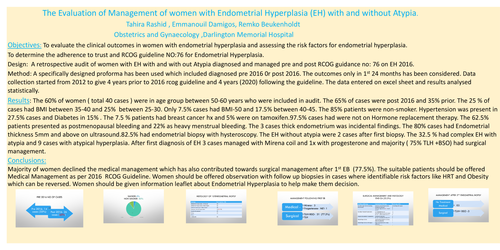
Results: The 60% of women ( total 40 cases ) were in age group between 50-60 years who were included in audit. The 65% of cases were post 2016 and 35% prior. The 25 % of cases had BMI between 35-40 and 25% between 25-30. Only 7.5% cases had BMI-50 and 17.5% between 40-45. The 85% patients were non-smoker. Hypertension was present in 27.5% cases and Diabetes in 15% . The 7.5 % patients had breast cancer hx and 5% were on tamoxifen.97.5% cases had were not on Hormone replacement therapy. The 62.5% patients presented as postmenopausal bleeding and 22% as heavy menstrual bleeding. The 3 cases thick endometrium was incidental findings. The 80% cases had Endometrial thickness 5mm and above on ultrasound.82.5% had endometrial biopsy with hysteroscopy. The EH without atypia were 2 cases after first biopsy. The 32.5 % had complex EH with atypia and 9 cases with atypical hyperplasia. After first diagnosis of EH 3 cases managed with Mirena coil and 1x with progesterone and majority ( 75% TLH +BSO) had surgical management.
Conclusions:
Majority of women declined the medical management which has also contributed towards surgical management after 1st EB (77.5%). The suitable patients should be offered Medical Management as per 2016 RCOG Guideline. Women should be offered observation with follow up biopsies in cases where identifiable risk factors like HRT and Obesity which can be reversed. Women should be given information leaflet about Endometrial Hyperplasia to help make them decision.