1,830 posters, 67 videos, 75 audios, 29 topics, 22 sessions, 4,727 authors, 1,697 institutions
ePostersLive by SciGen Technologies S.A. All rights reserved.
RCOG World Congress 2023
June 12 - 14, 2023 | London, UK

EP.1460
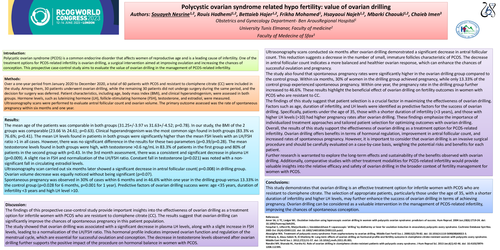
Polycystic ovarian syndrome related hypo fertility: value of ovarian drilling
Part of Topic
Reproductive Medicine/Assisted Reproduction
Polycystic ovarian syndrome related hypo fertility: value of ovarian drilling
Objective:
To evaluate ovarian drilling value in polycystic ovarian syndrome (PCOS) related hypo fertility treatment.
Design:
Prospective case-control study over a period of one year from January 2020 to December 2020.
Methods:
We included 60 patients with PCOS and resistant to clomiphene citrate (CC). Thirty patients had ovarian drilling and were compared to 30 patients who did not underwent surgery during the same period, in whom the indication for drilling was deferred.
Results:
The mean age of the patients was comparable in both groups (31.25+/-3.97 vs 31.63+/-4.52; p=0.78). In our study, the BMI of the 2 groups was comparable (23.66 Vs 24.61; p=0.63). Clinical hyperandrogenism was the most common sign found in both groups (83.3% vs 76.6%; p=0.41). The mean LH levels found in patients in both groups were significantly higher than the mean FSH levels with an LH/FSH ratio >1 in all cases. However, there was no significant difference in the results for these two parameters (p=0.39/p=0.28). The mean testosterone levels found in both groups were high, with testosterone >0.6 ng/mL in 83.3% of patients in the first group and 80% of patients in the second group with p=0.43. In the 3rd month assessment, there was a consistent and significant decrease in plasma LH (p=0.009). A slight rise in FSH and normalization of the LH/FSH ratio. Constant fall in testosterone (p=0.021) was noted with a non-significant fall in circulating estradiol levels.
Ultrasonography scan carried out six months later showed a significant decrease in antral follicular count( p=0.008) in drilling group. Ovarian volume decrease was equally noticed without being significant (p=0.07).
Spontaneous pregnancy was observed in 30% of cases within 6 months and in 46.6% within one year in the drilling group versus 13.33% in the control group (p=0.028 for 6 months, p=0.001 for 1 year). Predictive factors of ovarian drilling success were: age <35 years, duration of infertility <3 years and high LH level >10.
Conclusion:
Ovarian drilling is effective in the treatment of infertile women with PCOS resistant to CC. Patient selection may increase its effectiveness in terms of pregnancy rates.