1,830 posters, 67 videos, 75 audios, 29 topics, 22 sessions, 4,727 authors, 1,697 institutions
ePostersLive by SciGen Technologies S.A. All rights reserved.
RCOG World Congress 2023
June 12 - 14, 2023 | London, UK

EP.1459
Anti-depressants and the postpartum haemorrhage: What is the evidence?
Poster Presenter
Authors
Affiliations
Part of Topic
Hot Topics (Emerging research/issues) in Obstetrics
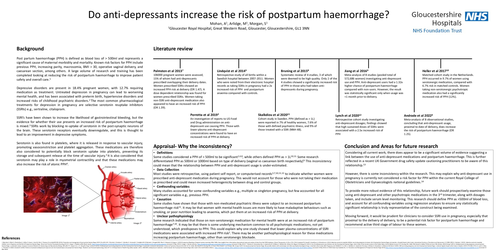
Do anti-depressants increase the risk of postpartum haemorrhage?
Background
Post partum haemorrhage (PPH) is defined as blood loss of > 500ml and represents a significant cause of maternal morbidity and mortality. Known risk factors for PPH include previous PPH, increasing parity, macrosomia, BMI > 30, operative vaginal delivery, and caesarean section, among others. A large volume of research and training has been completed looking at reducing the risk of postpartum haemorrhage to improve patient safety and overall care.1
Depressive disorders are present in 18.4% pregnant women, with 12.7% requiring medication as treatment. Untreated depression in pregnancy can lead to worsening mental health, and has been associated with preterm birth, hypertensive disorders and increased risks of childhood psychiatric disorders.2 The most common pharmacological treatments for depression in pregnancy are selective serotonin reuptake inhibitors (SSRIs) e.g., sertraline, citalopram.
SSRI’s have been shown to increase the likelihood of gastrointestinal bleeding, but the evidence for whether their use presents an increased risk of postpartum haemorrhage is mixed.3 SSRIs work by blocking re-uptake of serotonin in the post-synaptic neurons of the brain. These serotonin receptors eventually downregulate, and this is thought to lead to an improvement in depressive symptoms.
Serotonin is also found in platelets, where it is released in response to vascular injury, promoting vasoconstriction and platelet aggregation. These medications are therefore also considered to potentially block serotonin uptake into platelets, preventing its storage and subsequent release at the time of vascular injury.3 It is also considered that serotonin may play a role in myometrial contractility and that these medications may also increase the risk of atonic PPH4.
Literature review
Palmsten et al 20137
106000 pregnant women were assessed, 15% of whom had anti-depressants prescribed overlapping their delivery dates. Women prescribed SSRIs showed an increased PPH risk at delivery (OR 1.47). A dose dependent relationship was found for women prescribed SSRIs. Women taking non-SSRI anti-depressant medication also appeared to have an increased risk of PPH (OR 1.39).
Lindqvist et al 20143
Retrospective study of all births within a Swedish hospital between 2007-2011. Women who were noted from their electronic hospital records as taking SSRIs in pregnancy had a 2x increased risk of PPH and postpartum anaemia compared with controls.
Bruning et al 20158
Systematic review of 4 studies, 3 of which were deemed to bea high quality. Only 2 of the 4 studies showed a significantly increased risk of PPH in those who had taken anti-depressants during pregnancy.
Jiang et al 20169
Meta-analysis of 8 studies (pooled total of 572,686 women) investigating anti-depressant use and PPH. Anti-depressant users had a 1.32x higher chance of postpartum haemorrhage compared with non-users. However, the result was statistically significant only when usage was <1 month prior to delivery.
Heller et al 201710
Matched cohort study in the Netherlands. PPH occurred in 9.7% of women using serotonergic medication, compared with 6.7% risk in matched controls. Women taking non-serotonergic psychotropic medication also had a significantly increased risk of PPH (12%).
Perrotta et al 20192
An investigation of reports to US Food and Drug administration on anti-depressant use causing PPH. Those with lower plasma anti-depressant concentrations were found to have an increased risk of PPH at delivery.
Skalkdiou et al 202011
Cohort study in Sweden. PPH (defined as > 1L) were reported in 7% of healthy women, 7.6% of those with defined psychiatric illness, and 9% of those treated with a SSRI (NNH 48).
Lynch et al 202012
Retrospective cohort study investigating anti-depressant dosages; findings showed that high sustained doses of SSRIs were associated with a 2.5x increased risk of PPH
Andrade et al 20224
Meta-analysis of 8 observational studies, concluding that anti-depressant usage, proximal to date of delivery, does increase the risk of postpartum haemorrhage (OR 1.25).
Appraisal- why the inconsistency?
Some studies considered a PPH of > 500ml to be significant2,4,8, while others defined PPH as > 1L10,11. Some research differentiated PPH as 500ml or 1000ml based on type of delivery (vaginal vs caesarean birth respectively)9. This inconsistency could mean that the relationship between PPH and anti-depressant usage is under-estimated.
Most studies were retrospective, using patient self report, or computerised records3,7,10,11,12 to indicate whether women were prescribed anti-depressant medication during pregnancy. This would not account for those who were not taking their medication as prescribed and could mean increased heterogenicity between drug and control groups.
Many studies accounted for some confounding variables e.g., multiple vs singleton pregnancy, but few accounted for all significant variables e.g., previous PPH.
Some studies have shown that those with non-medicated psychiatric illness were subject to an increased postpartum haemorrhage risk11. It may be that women with mental health issues are more likely to have maladaptive behaviours such as smoking, or poor nutrition leading to anaemia, which put them at an increased risk of PPH at delivery.
Some research indicated that those on non-serotonergic medication for mental health were at an increased risk of postpartum haemorrhage7,10. It may be that there is some underlying mechanism common to all psychotropic medications, not yet understood, which predisposes to PPH. This could explain why one study showed that lower plasma concentrations of SSRI medications were associated with increased PPH risk2. There may be another pathophysiological reason for these medications increasing postpartum haemorrhage, other than serotonergic blockade.
Conclusion and areas for future research
Considering all current work, there does appear to be a significant volume of evidence suggesting a link between the use of anti-depressant medications and postpartum haemorrhage. This is further reflected in a recent UK Government drug safety update cautioning practitioners to be aware of this relationship.13
However, there is some inconsistency within the research. This may explain why anti-depressant use in pregnancy is currently not considered a risk factor for PPH within the current Royal College of Obstetricians and Gynaecologists national guidelines.14
To provide more robust evidence of this relationship, future work should prospectively examine those using anti-depressant and other psychotropic medications in the 3rd trimester, along with dosages taken, and include serum level monitoring. This research should define PPH as >500ml of blood loss, and account for all confounding variables using regression analyses to ensure any statistically significant relationship is truly representative of the construct being examined.
Moving forward, it would be prudent for clinicians to consider SSRI use in pregnancy, especially that proximal to the delivery of delivery, to be a potential risk factor for postpartum haemorrhage and recommend active third stage of labour to these women.