1,830 posters, 67 videos, 75 audios, 29 topics, 22 sessions, 4,727 authors, 1,697 institutions
ePostersLive by SciGen Technologies S.A. All rights reserved.
RCOG World Congress 2023
June 12 - 14, 2023 | London, UK

EP.1452
Termination Processes of Pregnancies Due to Intrauterine Mort Fetus And Fetal Anomaly
Poster Presenter
Authors
Affiliations
Part of Topic
Abortion Care
Termination Processes of Pregnancies Due to Intrauterine Mort Fetus and Fetal Anomaly
Tugba Akcaoglu1, Elif Ciler Eren1
1: Department of Obstetrics and Gynaecology, Istanbul Medipol University, Istanbul, Turkey
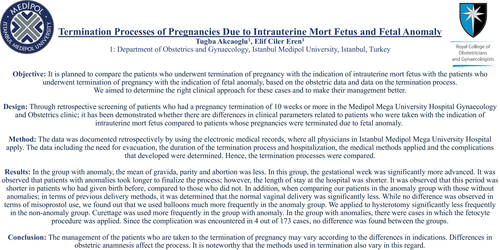
Objective: It is planned to compare the patients who underwenttermination of pregnancy with the indication of intrauterine mort fetuswith the patients who underwent termination of pregnancy with the indication of fetal anomaly, based on the obstetric data and data on the termination process. We aimed to determine the right clinicalapproach for these cases and to make their management better.
Design: Through retrospective screening of patients who had a pregnancy termination of 10 weeks or more in the Medipol Mega University Hospital Gynaecology and Obstetrics clinic; it has been demonstrated whether there are differences in clinical parameters related to patients who were taken with the indication of intrauterine mort fetuscompared to patients whose pregnancies were terminated due to fetal anomaly.
Method: The data was documented retrospectively by using the electronic medical records, where all physicians in Istanbul Medipol Mega University Hospital apply. The data including the need for evacuation, the duration of the termination process and hospitalization, the medical methods applied and the complications that developed were determined. Hence, the termination processes were compared.
Results: In the group with anomaly, the mean of gravida, parity and abortion was less. In this group, the gestational week was significantly more advanced. It was observed that patients with anomalies took longer to finalize the process; however, the length of stay at the hospital was shorter. It was observed that this period was shorter in patients who had given birth before, compared to those who did not. In addition, when comparing our patients in the anomaly group with those without anomalies; in terms of previous delivery methods, it was determined that the normal vaginal delivery was significantly less. While no difference was observed in terms of misoprostol use, we found out that we used balloons much more frequently in the anomaly group. We applied to hysterotomy significantly less frequently in the non-anomaly group. Curettage was used more frequently in the group with anomaly. In the group with anomalies, there were cases in which the fetocyte procedure was applied. Since the complication was encountered in 4 out of 173 cases, no difference was found between the groups.
Conclusion: The management of thepatients who are taken to the termination of pregnancy may vary according to the differences in indications. Differences in obstetric anamnesis affect the process. It is noteworthy that the methods used in termination also vary in this regard.