1,830 posters, 67 videos, 75 audios, 29 topics, 22 sessions, 4,727 authors, 1,697 institutions
ePostersLive by SciGen Technologies S.A. All rights reserved.
RCOG World Congress 2023
June 12 - 14, 2023 | London, UK

EP.1450
A review of babies born with low cord gases.
Poster Presenter
Authors
Affiliations
Part of Topic
Labour Ward Management
Review of babies born with low cord gases
Aim and objective
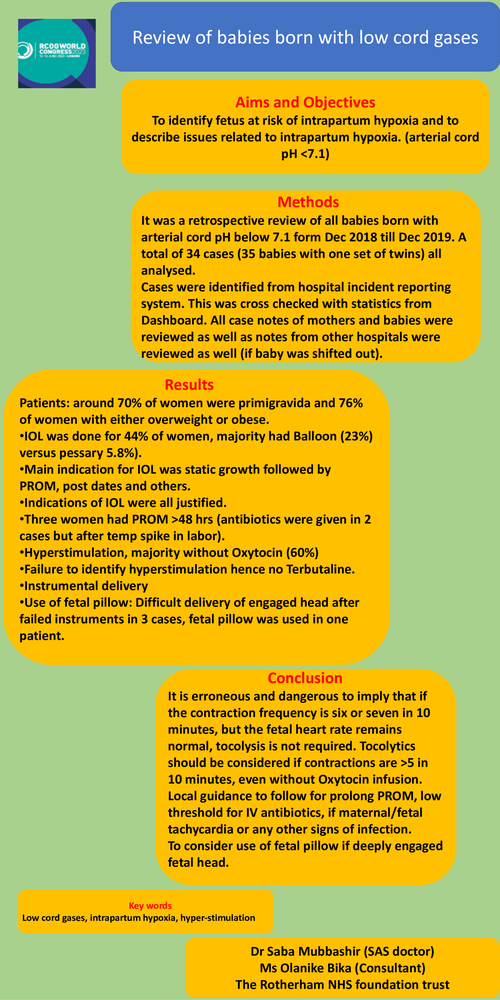
To identify fetus at risk of intrapartum hypoxia and to describe issues related to intrapartum hypoxia. (arterial cord pH <7.1)
Method
It was a retrospective review of all babies born with arterial cord pH below 7.1 form Dec 2018 till Dec 2019. A total of 34 cases (35 babies with one set of twins) all analyzed.
Cases were identified from hospital incident reporting system. This was cross checked with statistics from Dashboard. All case notes of mothers and babies were reviewed as well as notes from other hospitals were reviewed as well (if baby was shifted out).
Results
Twenty-three (67.6%) women were primigravida and 7 (2.5%) of women were multigravida. Twenty-five (73.4%) women with either overweight or obese. IOL was done for 44% of women, majority had Balloon (23%) versus pessary 5.8%).
Three women had PROM >48 hours (antibiotics were given in 2 cases but after temp spike in labor). Eleven women (31.4%) had normal vaginal delivery and 9 (25.5%) women had instrumental delivery. Fifteen women had cesarean section (42.8%) with difficult delivery at CS in 5 (33.3%) women. Delivery was complicated by shoulder dystocia in one woman.
Two (5.7%) babies were below 5th centile on growth scan.
Twenty-six babies (74.2) had APGAR score of 8-10, five babies (14.2%) had APGAR score of 4-7 and one (2.8%) baby had APGAR score of 1-3 at 5 minutes of birth. CTG abnormalities were noted in 30 patients (88%) and hyper-stimulation was noted in 15 patients (50%), 6 (40%) with Oxytocin and 9 (60%) without Oxytocin infusion.
Tocolytics were given in only one patient with uterine hyper-stimulation. Sequential instruments were associated with increased fetal morbidity. Fetal pillow for deeply impacted head was used in one out of three cases. Sixty percent of hyper-stimulation was without Oxytocin.
Conclusion
It is erroneous and dangerous to imply that if the contraction frequency is six or seven in 10 minutes but the fetal heart rate remains normal, tocolysis is not required. Tocolytics should be considered if contractions are >5 in 10 minutes, even without Oxytocin infusion.
Local guidance to follow for prolong PROM, low threshold for IV antibiotics, if maternal/fetal tachycardia or any other signs of infection.
To consider use of fetal pillow if deeply engaged fetal head.
Key words
Low cord gases, intrapartum hypoxia, hyper-stimulation