1,830 posters, 67 videos, 75 audios, 29 topics, 22 sessions, 4,727 authors, 1,697 institutions
ePostersLive by SciGen Technologies S.A. All rights reserved.
RCOG World Congress 2023
June 12 - 14, 2023 | London, UK

EP.1439
AUDIT OF ENDOMETRIAL CANCER CASES OVER ONE YEAR IN A DGH
Poster Presenter
Authors
Happy Tawadros, Ihab Abbasi, Chinedum Onebunne, Priyantha Kandanearachchi
Affiliations
Part of Topic
Gynae Oncology
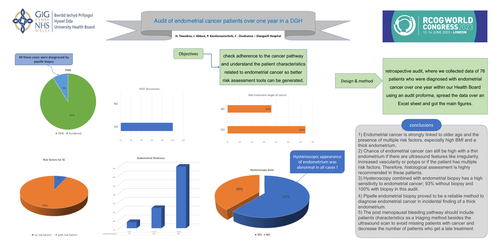
Objective: check adherence to the cancer pathway and understand the patient characteristics related to endometrial cancer so better risk assessment tools can be generated.
Design: retrospective audit.
Method: we collected data of 76 patients who were diagnosed with endometrial cancer over one year using an audit proforma, spread the data over an Excel sheet and got the main figures.
Results:
1) Out of 76 patients,only three were below the age of 50 and two thirds were above 60.
2) 7% of patients had no single recognised risk factor for endometrial cancer, where more than 80% had multiple risk factors combined.
3) Endometrial thickness was <4mm in 7% of patient, however the scan reported associated pathology in half of them, and was >10 mm in 70% of patients.
4) Only three patients had a completely normal pelvic ultrasound scan but all had multiple risk factors mainly BMI>30 and DM.
5) 61 patients underwent hysteroscopy, in 93% of cases it reported an abnormal or suspicious endometrium and only in 4 patients it was normal, these patients were all high BMI and their scan showed associated pathological features.
6) 9% of endometrial cancer cases were picked incidentally with no post-menopausal bleeding, the pipelle sample picked them all.
7) 27% of patients didn’t start on the USC pathway until the histology result came back, this contributed to 36% of patients whom first treatment got delayed beyond the national target of 62 days.
8) 100% of patients were discussed in the local gynaecology oncology MDT meetings.
Conclusions:
1) Endometrial cancer is strongly linked to older age and the presence of multiple risk factors, especially high BMI and a thick endometrium.
2) Chance of endometrial cancer can still be high with a thin endometrium if there are ultrasound features like irregularity, increased vascularity or polyps or if the patient has multiple risk factors. Therefore, histological assessment is highly recommended in these patients.
3) Hysteroscopy combined with endometrial biopsy has a high sensitivity to endometrial cancer; 93% without biopsy and 100% with biopsy in this audit.
4) Pipelle endometrial biopsy proved to be a reliable method to diagnose endometrial cancer in incidental finding of a thick endometrium.
5) The post menopausal bleeding pathway should include patients characteristics as a triaging method besides the ultrasound scan to avoid missing patients with cancer and decrease the number of patients who get a late treatment.