1,830 posters, 67 videos, 75 audios, 29 topics, 22 sessions, 4,727 authors, 1,697 institutions
ePostersLive by SciGen Technologies S.A. All rights reserved.
RCOG World Congress 2023
June 12 - 14, 2023 | London, UK

EP.1429
Evaluation of high-grade endometrial cancer management prior to implementing recent guidelines.
Poster Presenter
Part of Topic
Gynae Oncology
Evaluation of high-grade endometrial cancer management prior to implementation of recent guidelines.
Daniel Tan, Aiysha Islam, Dimina Kaludova, Iliana Armata, Pubudu N J Pathiraja
Objectives:
We aimed to evaluate the outcomes of patients with high-grade endometrial cancers (HGEC) Stage 1-2 that were treated surgically following local guidelines. The patients were treated prior to the introduction of the latest British Gynaecological Cancer Society recommendations released in 2021. The recent recommendations suggest patients with with high-intermediate risk or high-risk endometrial cancer should undergo lymph node sampling (LNS).
Design:
A retrospective cohort analysis of patients that received surgical treatment for HGEC at the Cambridge Gynaecological Oncology was conducted. Only patients with HGEC Stage 1-2 endometrial cancer were included in our study centre.
Methods:
Electronic records of 159 patients diagnosed with high-grade endometrial cancer between January 2015 and December 2021 were reviewed using ICD codes for malignant endometrial neoplasm. Diagnoses were initially made using imaging techniques and later confirmed by postoperative histological staging. Data pertaining to demographic characteristics, preliminary and final histology, operative details and multidisciplinary team decisions were collected. Primary and secondary surgical outcomes, including recurrence rates and significant difference in staging after pelvic lymph node sampling (LNS) were also assessed. Subsequent data analysis was performed using RStudio® and MS Excel®, using chi-squared tests, with statistical significance levels of p < 0.05.
Results:
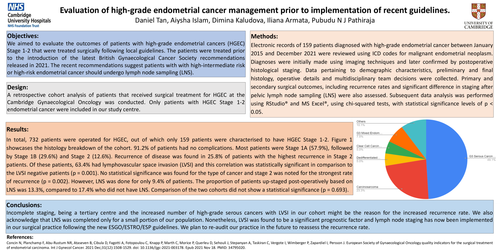
In total, 732 patients were operated for HGEC, out of which only 159 patients were characterised to have HGEC Stage 1-2. Figure 1 showcases the histology breakdown of the cohort. 91.2% of patients had no complications. Most patients were Stage 1A (57.9%), followed by Stage 1B (29.6%) and Stage 2 (12.6%). Recurrence of disease was found in 25.8% of patients with the highest recurrence in Stage 2 patients. Of these patients, 63.4% had lymphovascular space invasion (LVSI) and this correlation was statistically significant in comparison to the LVSI negative patients (p = 0.001). No statistical significance was found for the type of cancer and stage 2 was noted for the strongest rate of recurrence (p = 0.002). However, LNS was done for only 9.4% of patients. The proportion of patients up-staged post-operatively based on LNS was 13.3%, compared to 17.4% who did not have LNS. Comparison of the two cohorts did not show a statistical significance (p = 0.693).
Conclusions:
Incomplete staging, being a tertiary centre and the increased number of high-grade serous cancers with LVSI in our cohort might be the reason for the increased recurrence rate. We also acknowledge that LNS was completed only for a small portion of our population. Nonetheless, LVSI was found to be a significant prognostic factor and lymph node staging has now been implemented in our surgical practice following the new ESGO/ESTRO/ESP guidelines. We plan to re-audit our practice in the future to reassess the recurrence rate.
References:
Concin N, Planchamp F, Abu-Rustum NR, Ataseven B, Cibula D, Fagotti A, Fotopoulou C, Knapp P, Marth C, Morice P, Querleu D, Sehouli J, Stepanyan A, Taskiran C, Vergote I, Wimberger P, Zapardiel I, Persson J. European Society of Gynaecological Oncology quality indicators for the surgical treatment of endometrial carcinoma. Int J Gynecol Cancer. 2021 Dec;31(12):1508-1529. doi: 10.1136/ijgc-2021-003178. Epub 2021 Nov 18. PMID: 34795020.