1,830 posters, 67 videos, 75 audios, 29 topics, 22 sessions, 4,727 authors, 1,697 institutions
ePostersLive by SciGen Technologies S.A. All rights reserved.
RCOG World Congress 2023
June 12 - 14, 2023 | London, UK

EP.1422
An audit evaluating antibiotic prophylaxis administration in mothers following assisted vaginal delivery
Poster Presenter
Part of Topic
Labour Ward Management
Title
An audit evaluating antibiotic prophylaxis administration in mothers following assisted vaginal delivery
Abstract
Objective
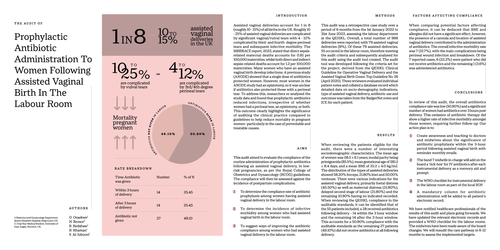
This audit aimed to evaluate the compliance of the routine administration of prophylactic antibiotics following an assisted vaginal delivery, as per the Royal College of Obstetrics and Gynaecology (RCOG) guidelines. The compliance will then be assessed against the incidence of postpartum complications.
Design
The audit was a retrospective cross-sectional study spanning a six-month period from 1st January – 30th June 2022.
Methodology
Following consent and approval from the hospital, the electronic notes for eligible patients were retrieved and the relevant data extracted. The inclusion criteria encompassed patients who underwent assisted vaginal delivery in the labour room; and those who received this treatment in theatres were excluded. This data was analysed using the WinPepi programme; and the test of significance was determined by the Chi-Squared test, with a p-value set at 0.05.
Results
This audit included fifty-five patients with a majority (85%) being nulliparous with a mean age of 28.5±6.1 years. In the cohort, the mean gestational age was 281.2±8.4 days and the mean body mass index was 25.2±4.0. During assisted delivery, 58.2% received forceps, 21.8% experienced kiwi, and 20.0% had ventouse delivery. The commonest indication of assisted delivery was foetal distress in the second stage of labour (45.5%). Similarly, all women had an episiotomy during the procedure. Assessing these cases, antibiotic compliance was 50.9% with a mere 25.5% receiving it within 3-hours of delivery. Regardless, only 7 women (12.7%) returned with postpartum infective morbidity. Furthermore, the Pearson Chi-Squared test, with Yate’s correction applied, aimed to determine any significant difference between antibiotic administration and incidence of postpartum complications; this showed a p-value of 0.095.
Conclusion
Overall, this study demonstrated a low compliance with the RCOG recommendations for routine postnatal antibiotics with assisted deliveries. It further highlighted that among the women meeting the criteria for low-risk labour room assisted delivery, there appeared to be no significant difference in the postpartum infective morbidity between those that did and did not receive antibiotics. These findings negate current research which proposes that prophylactic intravenous antibiotics are effective in reducing puerperal morbidities, namely, in superficial and deep perineal wound infections[2].
References:
1. Assisted Vaginal Birth RCOG Green-top Guideline No. 26
2. Libsuetrakul T, Choobun T, Peeyananjarassri K, Islam QM Antibiotic prophylaxis for operative vaginal delivery. Cochrane Database Syst Rev. 2020 Mar 26.
Categories (required)
Labour Ward Management
Authors and Affiliations (required)
Dr ObinnaIzuchukwu Oraekwe obinnaizuchukwu.oraekwe@qehkl.nhs.uk
Queen Elizabeth Hospital King's Lynn, King's Lynn, United Kingdom
Miss Hannah Brown h.brown2@uea.ac.uk
Norwich Medical School-University of East Anglia, Norwich, United Kingdom
Dr Rezwana Rahman rezwana.rahman@qehkl.nhs.uk
Queen Elizabeth Hospital King's Lynn, King's Lynn, United Kingdom
Miss Saba Al-Juboori (Presenting) saba.aljuboori@doctors.org.uk
Queen Elizabeth Hospital King's Lynn, King's Lynn, United Kingdom