1,830 posters, 67 videos, 75 audios, 29 topics, 22 sessions, 4,727 authors, 1,697 institutions
ePostersLive by SciGen Technologies S.A. All rights reserved.
RCOG World Congress 2023
June 12 - 14, 2023 | London, UK

EP.1414
Interprofessional obstetric simulation training for undergraduates to improve understanding of professional roles
Poster Presenter
Part of Topic
Simulation and Training
INTERPROFESSIONAL OBSTETRIC SIMULATION TRAINING FOR ENHANCED UNDERSTANDING OF PROFESSIONAL ROLES AMONG UNDERGRADUATES
Aditi Siddharth1, Gbemisola David West2, Jane Carpenter3, Ethel Burns3, Matthew Catterall3, Jane Moore4
1. Nuffield Department of Clinical Neurosciences and OXSTaR, Oxford 2. Milton Keynes Hospital, Milton Keynes 3. Oxford Brookes University, Oxford 4. Oxford University Hospitals, Oxford
WHY SHOULD MEDICAL, MIDWIFERY AND PARAMEDICAL STUDENTS TRAIN TOGETHER?
Interprofessional education (IPE) is increasingly recognised as a valuable tool in healthcare education, particularly for improving communication, collaboration, and patient outcomes (Kenaszchuk et al., 2011, Kyrkjebo et al., 2006, Foronda et al., 2016). In obstetrics, where a multidisciplinary approach is essential, interprofessional collaboration is especially crucial. Unfortunately, medical, midwifery, and paramedical students often receive training in silos, limiting opportunities for collaborative learning and professional development.
To address this gap, we developed an interprofessional obstetric simulation training program embedded into the patient safety day for Oxford medical, Oxford Brookes midwifery, and paramedical students. This program aimed to enhance students' understanding of professional roles, strengths, and unique contributions of each healthcare profession through team-based simulations of obstetric emergencies. The primary objective of this poster is to present the results of the program and demonstrate the significance of interprofessional education in promoting effective teamwork in obstetrics.
HOW WAS THE SIMULATION TRAINING SET UP?
DEVELOPING THE MATERIALS
CONDUCTING THE SIMULATION
WHAT WAS THE IMPACT?
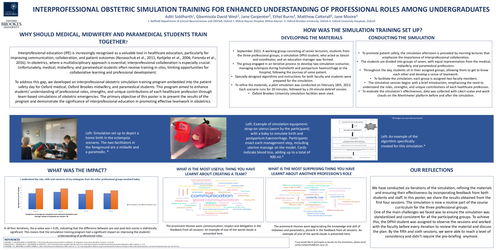
In all four iterations, the p-value was < 0.05, indicating that the difference between pre and post-test scores is statistically significant. This means that the simulation training program had a significant impact on improving the students' understanding of professional roles.
WHAT IS THE MOST USEFUL THING YOU HAVE LEARNT ABOUT CREATING A TEAM?
The prominent themes were communication, respect and delegation in the feedback from all sessions. An example of one of the world clouds is presented here.
WHAT IS THE MOST SURPRISING THING YOU HAVE LEARNT ABOUT ANOTHER PROFESSION'S ROLE?
The prominent themes were appreciating the knowledge and skill of midwives and paramedics, present in the feedback from all sessions. An example of one of the world clouds is presented here.
OUR REFLECTIONS
We have conducted six iterations of the simulation, refining the materials and ensuring their effectiveness by incorporating feedback from both students and staff. In this poster, we share the results obtained from the first four sessions. The simulation is now a routine part of the course curriculum for the three professional groups.
One of the main challenges we faced was to ensure the simulation was standardised and consistent for all the participating groups. To achieve this, the DPhil student was assigned to observe the sessions and worked with the faculty before every iteration to review the material and discuss the plan. By the fifth and sixth sessions, we were able to reach a level of consistency and didn't require the pre-briefing anymore.
REFERENCES
FORONDA, C., MACWILLIAMS, B. & MCARTHUR, E. 2016.Interprofessional communication in healthcare: An integrative review. Nurse education in practice, 19, 36-40.
KENASZCHUK, C., MACMILLAN, K., VAN SOEREN, M. & REEVES, S. 2011.Interprofessional simulated learning: short-term associations between simulation and interprofessional collaboration. BMC medicine, 9, 1-10.
KYRKJEBØ, J. M., BRATTEBØ, G. & SMITH-STRØM, H. 2006. Interprofessional collaboration. BMC medicine, 9, 1-10. Improving patient safety by using interprofessional simulation training in health professional education. Journal of interprofessional care, 20, 507-516.