1,830 posters, 67 videos, 75 audios, 29 topics, 22 sessions, 4,727 authors, 1,697 institutions
ePostersLive by SciGen Technologies S.A. All rights reserved.
RCOG World Congress 2023
June 12 - 14, 2023 | London, UK

EP.1400
Mysterious skin changes in the second trimester: a Case report
Poster Presenter
Part of Topic
Maternal Medicine
Mysterious skin changes in the second trimester: a Case report
Kaan E. UZUN, MD; Mustafa UZUN,MD.
Objective: Pigmentary demarcation lines (PDL), also known as Futcher or Voigt lines, are abrupt transitions between darker and lighter pigmentation areas. Although dermatology clinics recognize such skin changes well, obstetric clinics can be weak. In this case report, the skin change observed in a patient followed by our clinic, who was consulted to different dermatology clinics to be diagnosed, will be presented.
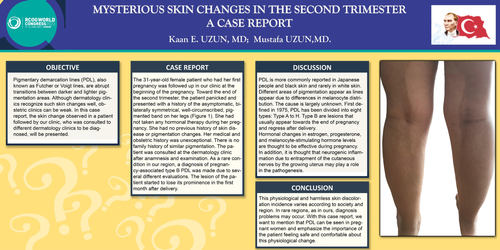
Case report: The 31-year-old female patient who had her first pregnancy was followed up in our clinic at the beginning of the pregnancy. Toward the end of the second trimester, the patient panicked and presented with a history of the asymptomatic, bilaterally symmetrical, well-circumscribed, pigmented band on her legs (Figure 1). She had not taken any hormonal therapy during her pregnancy. She had no previous history of skin disease or pigmentation changes. Her medical and obstetric history was unexceptional. There is no family history of similar pigmentation. The patient was consulted at the dermatology clinic after anamnesis and examination. As a rare condition in our region, a diagnosis of pregnancy-associated type B PDL was made due to several different evaluations. The lesion of the patient started to lose its prominence in the first month after delivery.
Discussion: PDL is more commonly reported in Japanese people and black skin and rarely in white skin. Different areas of pigmentation appear as lines appear due to differences in melanocyte distribution. The cause is largely unknown. First defined in 1975, PDL has been divided into eight types: Type A to H. Type B are lesions that usually appear towards the end of pregnancy and regress after delivery.
Hormonal changes in estrogen, progesterone, and melanocyte-stimulating hormone levels are thought to be effective during pregnancy. In addition, it is thought that neurogenic inflammation due to entrapment of the cutaneous nerves by the growing uterus may play a role in the pathogenesis.
Conclusions: This physiological and harmless skin discoloration incidence varies according to society and region. In rare regions, as in ours, diagnosis problems may occur. With this case report, we want to mention that PDL can be seen in pregnant women and emphasize the importance of the patient feeling safe and comfortable about this physiological change.