1,830 posters, 67 videos, 75 audios, 29 topics, 22 sessions, 4,727 authors, 1,697 institutions
ePostersLive by SciGen Technologies S.A. All rights reserved.
RCOG World Congress 2023
June 12 - 14, 2023 | London, UK

EP.1393
Autocorrection: a case of congenitally corrected transposition of great arteries
Poster Presenter
Authors
Affiliations
Part of Topic
Fetal Medicine
Autocorrection: a case of congenitally corrected transposition of great arteries
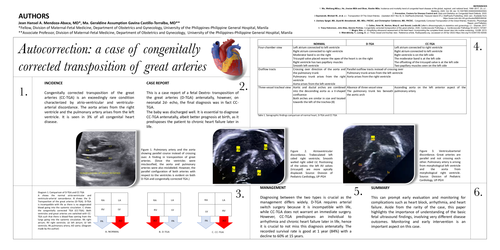
Congenitally corrected transposition of the great arteries (CC-TGA) is an exceedingly rare condition characterized by atrio-ventricular and ventriculo- arterial discordance. The aorta arises from the right ventricle and the pulmonary artery arises from the left ventricle. It is seen in 3% of all congenital heart disease.
This is a case report of a fetal Dextro- transposition of the great arteries (D-TGA) antenatally, however, on neonatal 2d- echo, the final diagnosis was in fact CC-TGA.
The baby was discharged well. It is essential to diagnose CC-TGA antenatally, albeit better prognosis at birth, as it predisposes the patient to chronic heart failure later in life.
Diagnosing it relies on proper identification of the atrial-ventricular-arterial connection sonographically. In D-TGA, four chamber view is the same as the normal atrio-ventricular concordance. The tricuspid attaches nearer the apex of the right ventricle. The moderator band is at the right side, and the right ventricle has a shorter lumen than the left. The right ventricle has two papillary muscles, but with smooth left ventricle. In contrast, in CC-TGA, the right ventricle is on the left side. The tricuspid valve is on the left side; thus the lower attachment can be seen on the left side. The moderator band is also on the left side, with shorter lumen seen on the left-sided right ventricle. The left ventricle has two papillary muscles, while there are no chordal attachments on the right sided ventricle. Both TGA, however differs from the normal heart by seeing parallel course of the great vessels instead of crossing over. In the three vessel-tracheal view, the pulmonary artery lies on the left of the aorta in CC-TGA.
Diagnosing between the two types is crucial as the management differs widely. D-TGA requires arterial switch surgery because it is incompatible with life, while CC-TGA does not warrant an immediate surgery. However, CC-TGA predisposes an individual to arrhythmia and chronic heart failure later in life, hence it is crucial to not miss this diagnosis antenatally. The recorded survival rate is good at 1 year (84%) with a decline to 60% at 15 years.
This can prompt early evaluation and monitoring for complications such as heart block, arrhythmia, and heart failure. Aside from the rarity of the case, this paper highlights the importance of understanding of the basic fetal ultrasound findings, involving very different disease outcomes. Monitoring and early intervention is an important aspect on this case.