1,830 posters, 67 videos, 75 audios, 29 topics, 22 sessions, 4,727 authors, 1,697 institutions
ePostersLive by SciGen Technologies S.A. All rights reserved.
RCOG World Congress 2023
June 12 - 14, 2023 | London, UK

EP.1390
Rare presentation of spigelian hernia in an adolescent female: A diagnostic challenge
Poster Presenter
Authors
Affiliations
Part of Topic
Adolescent Gynaecology
Rare presentation of Spigelian hernia in an adolescent female: A diagnostic challenge
Deepika Pannu, Patricia Lutalo, Vasanth Andrews
Objective
•We present a rare case of a spigelian hernia in a young girl that was initially treated as a tubo-ovarian abscess before the correct diagnosis was made
Case report
•Twelve year old girl presented to hospital with chronic abdominal pain which was worsening.
•On palpation there was an irregular tender mass arising from the right side of the pelvis
•MRI of the pelvis showed a right tubo-ovarian abscess with a few sinus formations
•The changes were thought to be secondary to a granulomatous disease such as a tuberculosis
•Tests for tuberculosis were negative
•A repeat MRI after ten days of intravenous antibiotics showed a persistent abscess
•CT guided drainage of the suspected abscess was undertaken
•Repeat imaging demonstrated an increase in size of the mass after drainage
•An exploratory laparoscopy was therefore undertaken
•A right sided spigelian hernia was diagnosed with incarcerated omentum and the hernia was repaired at the time of surgery
•The incarceration and strangulation of the omentum led to the abscess which was also removed at surgery
Discussion
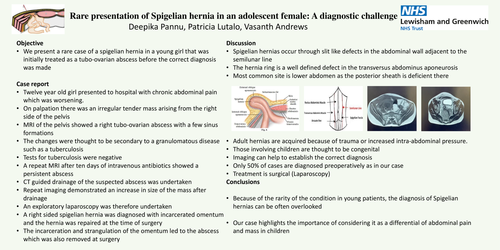
•Spigelian hernias occur through slit like defects in the abdominal wall adjacent to the semilunar line
•The hernia ring is a well defined defect in the transversus abdominus aponeurosis
•Most common site is lower abdomen as the posterior sheath is deficient there
•Adult hernias are acquired because of trauma or increased intra-abdominal pressure.
•Those involving children are thought to be congenital
•Imaging can help to establish the correct diagnosis
•Only 50% of cases are diagnosed preoperatively as in our case
•Treatment is surgical (Laparoscopy)
Conclusions
•Because of the rarity of the condition in young patients, the diagnosis of Spigelian hernias can be often overlooked
•
•Our case highlights the importance of considering it as a differential of abdominal pain and mass in children