1,830 posters, 67 videos, 75 audios, 29 topics, 22 sessions, 4,727 authors, 1,697 institutions
ePostersLive by SciGen Technologies S.A. All rights reserved.
RCOG World Congress 2023
June 12 - 14, 2023 | London, UK

EP.1388
Early Twin-twin transfusion syndrome – a case of successful fetoscopic anastomosis ablation
Poster Presenter
Part of Topic
Fetal Medicine
Early Twin-twin transfusion syndrome – a case of successful fetoscopic anastomosis ablation
Ana Sofia Carneiro1, Rosa Sardinha1, Adosinda Rosmaninho1, Elsa Pereira1, Cátia Ferreira1, Pedro Oliveira1, Catarina Ferreira1, Claúdia Pinto1, Álvaro Cohen2
1- Hospital Senhora da Oliveira, Guimarães, Portugal; 2 -Maternidade Alfredo da Costa, Lisboa, Portugal
Objective:
Twin-Twin Transfusion Syndrome (TTTS) is a condition that can affect twin monochorionic gestations.
Prenatal diagnose of TTTS, is made by ultrasound. It must show a monochorionic diamniotic pregnancy, in which one twin has oligohydramnios, and the other has polyhydramnios.
We report a case of early TTTS in a monochorionic diamniotic twin pregnancy, successfully treated with fetoscopic anastomosis ablation.
Case Report
A 29-years old healthy, primigravida, followed in our hospital obstetrics consultation for a monochorionic diamniotic, spontaneous pregnancy, complicated with gestational diabetes.
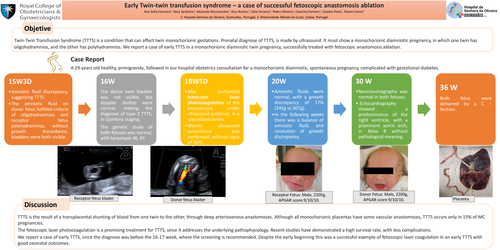
At 15 weeks and 3 days, routine ultrasound showed an amniotic fluid discrepancy, suggesting TTTS. The amniotic fluid on donor fetus fulfilled criteria of oligohydramnios and receptor fetus polyhydramnios, without growth discordance, bladders were both visible.
Daily ultrasound evaluation was performed with progressively worsened condition. At 16weeks of pregnancy, the donor twin bladder was not visible, but doppler studies were normal, making the diagnose of type 2 TTTS, in Quintero staging.
The genetic study of both fetuses was normal, with karyotype 46, XY.
At 18 weeks and 5 days was performed fetoscopic laser photocoagulation of the anastomosis under ultrasound guidance, in a specialized centre.
Weekly ultrasound surveillance was performed.
At week 20 both amniotic fluids were normal, with a growth discrepancy of 17% (245g vs 307g). In the following weeks there was a balance of amniotic fluid, and resolution of growth discrepancy.
Neurossonography at week 30 was normal in both fetuses. Echocardiography showed a predominance of the right ventricle, with a prominent aortic arch, in fetus B without pathological meaning.
The gestation proceeded without any other complications.
At 36 weeks it was performed a caesarean-section: fetus A: male, 2105g, APGAR score 9/10/10 and fetus B: male, 2200g, APGAR score 9/10/10.
The babies are being followed in Pediatrics department with normal psychomotor development.
Discussion
TTTS is the result of a transplacental shunting of blood from one twin to the other, through deep arteriovenous anastomoses. Although all monochorionic placentas have some vascular anastomoses, TTTS occurs only in 15% of MC pregnancies.
The fetoscopic laser photocoagulation is a promising treatment for TTTS, since it addresses the underlying pathophysiology. Recent studies have demonstrated a high survival rate, with less complications.
We report a case of early TTTS, since the diagnose was before the 16-17 week, where the screening is recommended. Despite the early beginning this was a successful example of fetoscopic laser coagulation in an early TTTS with good neonatal outcomes.