1,830 posters, 67 videos, 75 audios, 29 topics, 22 sessions, 4,727 authors, 1,697 institutions
ePostersLive by SciGen Technologies S.A. All rights reserved.
RCOG World Congress 2023
June 12 - 14, 2023 | London, UK

EP.1386
Rare Occurrence of Bell's Palsy in Pregnancy in a Low Resource Setting
Poster Presenter
Authors
Affiliations
Part of Topic
Maternal Medicine
Rare occurrence of Bell’s Palsy in Pregnancy in a low resource setting
Introduction:
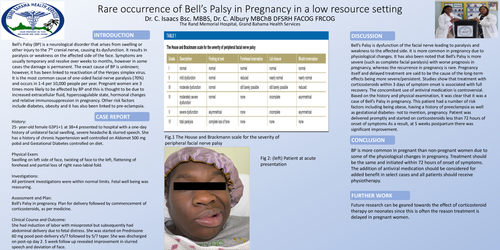
Bell’s Palsy (BP) is a neurological disorder that arises from swelling or other injury to the 7th cranial nerve, causing its dysfunction. It results in paralysis or weakness on the affected side of the face. Symptoms are usually temporary and resolve over weeks to months, however in some cases the damage is permanent. The exact cause of BP is unknown; however, it has been linked to reactivation of the Herpes simplex virus. It is the most common cause of one-sided facial nerve paralysis (70%) and occurs in 1-4 per 10,000 people per year. Pregnant women are 3 times more likely to be affected by BP and this is thought to be due to increased extracellular fluid, hypercoagulable state, hormonal changes and relative immunosuppression in pregnancy. Other risk factors include diabetes, obesity and it has also been linked to pre-eclampsia.
Case Report
History:
30-year-old female primigravida at 9+3 presented with a 5-day history of cramping abdominal pain and PV bleeding with clots and fleshy material.
Physical Exam:
Patiett had mild tenderness in the suprapubic region, minimal dark red blood in the vault and cervix opened to 2cm.
Investigations:
Urine beta HCG was positive, blood group B-positive and Hemoglobin was 13.2 mg/dL. Pelvic USS revealed No intrauterine pregnancy with mild retained products of conception in uterus.
Surgical Findings and Hospital Course
Patient had evacuation of retained products of conception. Findings at surgery included normal vulva, vagina with anterior septum, 2 cervices and 2 uteri. Cervix on left 2 cm dilated, uterus sound to 10 cm. Cervix on right one cm dilated, uterus sound to 7 cm. Adnexa normal. Curetting’s +++. Patient tolerated procedure, was counselled about findings and discharged the following day. Histology revealed to be products of conception.
Discussion
Bell’s Palsy is dysfunction of the facial nerve leading to paralysis and weakness to the affected side. It is more common in pregnancy due to physiological changes. It has also been noted that Bell’s Palsy is more severe (such as complete facial paralysis) with worse prognosis in pregnancy, whereas the recurrence in pregnancy is rare. Pregnancy itself and delayed treatment are said to be the cause of the long-term effects being more severe/persistent. Studies show that treatment with corticosteroids within 3 days of symptom onset is associated with full recovery. The concomitant use of antiviral medication is controversial.
Based on the history and physical examination, it was clear that it was a case of Bell’s Palsy in pregnancy. This patient had a number of risk factors including being obese, having a history of preeclampsia as well as gestational diabetes- not to mention, pregnancy. Patient was delivered promptly and started on corticosteroids less than 72 hours of onset of symptoms As a result, at 5 weeks postpartum there was significant improvement.
Conclusion
BP is more common in pregnant than non-pregnant women due to some of the physiological changes in pregnancy. Treatment should be the same and initiated within 72 hours of onset of symptoms. The addition of antiviral medication should be considered for added benefit in select cases and all patients should receive physiotherapy.
Further Work
Future research can be geared towards the effect of corticosteroid therapy on neonates since this is often the reason treatment is delayed in pregnant women.