1,830 posters, 67 videos, 75 audios, 29 topics, 22 sessions, 4,727 authors, 1,697 institutions
ePostersLive by SciGen Technologies S.A. All rights reserved.
RCOG World Congress 2023
June 12 - 14, 2023 | London, UK

EP.1385
A large Cervical fibroid, in subtotal hysterectomy patient, diagnostic and surgical challenges
Poster Presenter
Authors
Affiliations
Part of Topic
Benign Gynaecology
Objective:
Leiomyomas are the most common uterine tumours but only 1-2 % are confined to the cervix. Cervical fibroids expand equally in all directions and mainly cause pressure symptoms. Our case highlights the importance of considering cervical fibroid originating from the cervical stump as a differential diagnosis; in patients presenting with pressure symptoms associated with pelvic mass following subtotal hysterectomy.
Case report:
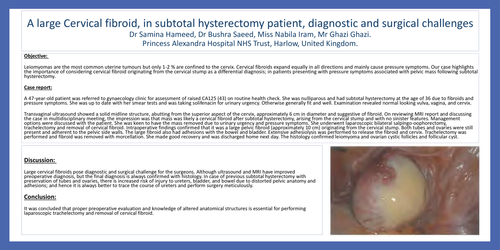
A 47-year-old patient was referred to gynaecology clinic for assessment of raised CA125 (43) on routine health check. She was nulliparous and had subtotal hysterectomy at the age of 36 due to fibroids and pressure symptoms. She was up to date with her smear tests and was taking solifenacin for urinary urgency. Otherwise generally fit and well. Examination revealed normal looking vulva, vagina, and cervix.
Transvaginal ultrasound showed a solid midline structure, abutting from the superior aspect of the cervix, approximately 6 cm in diameter and suggestive of fibroid. On reviewing MRI report and discussing the case in multidisciplinary meeting, the impression was that mass was likely a cervical fibroid after subtotal hysterectomy, arising from the cervical stump and with no sinister features. Management options were discussed with the patient. She was keen to have the mass removed due to urinary urgency and pressure symptoms. She underwent laparoscopic bilateral salpingo-oophorectomy, trachelectomy and removal of cervical fibroid. Intraoperative findings confirmed that it was a large pelvic fibroid (approximately 10 cm) originating from the cervical stump. Both tubes and ovaries were still present and adherent to the pelvic side walls. The large fibroid also had adhesions with the bowel and bladder. Extensive adhesiolysis was performed to release the fibroid and cervix. Trachelectomy was performed and fibroid was removed with morcellation. She made good recovery and was discharged home next day. The histology confirmed leiomyoma and ovarian cystic follicles and follicular cyst.
Discussion:
Large cervical fibroids pose diagnostic and surgical challenge for the surgeons. Although ultrasound and MRI have improved preoperative diagnosis, but the final diagnosis is always confirmed with histology. In case of previous subtotal hysterectomy with preservation of tubes and ovaries, there is increased risk of injury to ureters, bladder, and bowel due to distorted pelvic anatomy and adhesions; and hence it is always better to trace the course of ureters and perform surgery meticulously.
Conclusion:
It was concluded that proper preoperative evaluation and knowledge of altered anatomical structures is essential for performing laparoscopic trachelectomy and removal of cervical fibroid.