1,830 posters, 67 videos, 75 audios, 29 topics, 22 sessions, 4,727 authors, 1,697 institutions
ePostersLive by SciGen Technologies S.A. All rights reserved.
RCOG World Congress 2023
June 12 - 14, 2023 | London, UK

EP.1380
Cardiac Conditions Among Pregnant Women in the time of COVID-19 Pandemic
Poster Presenter
Part of Topic
Pandemic and impact of Covid/Infectious Diseases
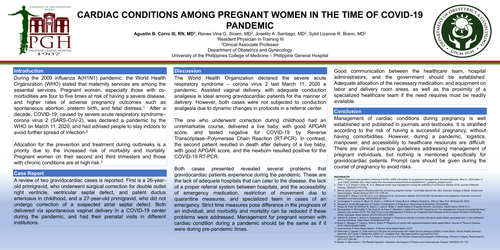
CARDIAC CONDITIONS AMONG PREGNANT WOMEN IN THE TIME OF COVID-19 PANDEMIC
Agustin B. Corro III, RN, MD1, Renee Vina G. Sicam, MD2, Joselito A. Santiago, MD2, Sybil Lizanne R. Bravo, MD2
1Resident Physician in Training III
2Clinical Associate Professor
Department of Obstetrics and Gynecology
University of the Philippines College of Medicine – Philippine General Hospital
Introduction
During the 2009 influenza A(H1N1) pandemic, the World Health Organization (WHO) stated that maternity services are among the essential services. Pregnant women, especially those with co-morbidities are four to five times at risk of having a severe disease, and higher rates of adverse pregnancy outcomes such as spontaneous abortion, preterm birth, and fetal distress.1 After a decade, COVID-19, caused by severe acute respiratory syndrome–corona virus 2 (SARS-CoV-2), was declared a pandemic by the WHO on March 11, 2020, and had advised people to stay indoors to avoid further spread of infection.2
Allocation for the prevention and treatment during outbreaks is a priority due to the increased risk of morbidity and mortality. Pregnant women on their second and third trimesters and those with chronic conditions are at high risk.3
Case Report
A review of two gravidocardiaccases is reported. First is a 26-year-old primigravid, who underwent surgical correction for double outlet right ventricle, ventricular septal defect, and patent ductus arteriosus in childhood, and a 27-year-old primigravid, who did not undergo correction of a suspected atrial septal defect. Both delivered via spontaneous vaginal delivery in a COVID-19 center during the pandemic, and had their prenatal visits in different institutions.
Discussion
The World Health Organization declared the severe acute respiratory syndrome – corona virus 2 last March 11, 2020 a pandemic. Assisted vaginal delivery, with adequate conduction analgesia is ideal among gravidocardiac patients for the manner of delivery. However, both cases were not subjected to conduction analgesia due to dynamic changes in protocols in a referral center.
The one who underwent correction during childhood had an unremarkable course, delivered a live baby, with good APGAR score, and tested negative for COVID-19 by Reverse Transcriptase–Polymerase Chain Reaction (RT-PCR). In contrast, the second patient resulted in death after delivery of a live baby, with good APGAR score, and the newborn resulted positive for the COVID-19 RT-PCR.
Both cases presented revealed several problems that gravidocardiac patients experience during the pandemic. These are the lack of adequate hospitals that can cater to the disease, the lack of a proper referral system between hospitals, and the accessibility of emergency medication, restriction of movement due to quarantine measures, and specialized team in cases of an emergency. Strict time measures pose difference in the prognosis of an individual, and morbidity and mortality can be reduced if these problems were addressed. Management for pregnant women with cardiac condition during a pandemic should be the same as if it were during pre-pandemic times.
Good communication between the healthcare team, hospital administrators, and the government should be established. Adequate allocation of the necessary medication, and equipment on labor and delivery room areas, as well as the proximity of a specialized healthcare team if the need requires must be readily available.
Conclusion
Management of cardiac conditions during pregnancy is well established and published in journals and textbooks. It is stratified according to the risk of having a successful pregnancy, without having comorbidities. However, during a pandemic, logistics, manpower, and accessibility to healthcare resources are difficult. There are clinical practice guidelines addressing management of pregnant individuals, but nothing is mentioned specifically for gravidocardiac patients. Prompt care should be given during the course of pregnancy to avoid risks.