1,830 posters, 67 videos, 75 audios, 29 topics, 22 sessions, 4,727 authors, 1,697 institutions
ePostersLive by SciGen Technologies S.A. All rights reserved.
RCOG World Congress 2023
June 12 - 14, 2023 | London, UK

EP.1366
Intrauterine insemination pregnancy resulting in triplets complicated with TRAP syndrome
Poster Presenter
Authors
Nadia Islam, Rachel Harris, Ameh Sunday, Olivia Serevina, Kula Abdusamad
Affiliations
Part of Topic
High Risk Pregnancy
Intrauterine insemination pregnancy resulting in triplets complicated with twin reverse arterial perfusion (TRAP) syndrome and preterm delivery
Harris RE, Islam N, Serevina OL, Ameh SA Abdusamad K
Case presentation
- A thirty-one-year-old primigravida, with an IUI dichorionic triamniotic triplet pregnancy.
- USS showed fetus 1 with separate placenta and sac; fetus 2 “pump” twin and fetus 3 “acardiac” twin sharing a placenta (monochorionic TRAP).
- She was under the care of Royal Bolton Hospital with fetal medicine unit input from St Mary’s Hospital.
- At 24+4 weeks gestation she attended with PPROM and within 24 hours delivered the singleton triplet (fetus 1) via spontaneous vaginal delivery; labour did not
progress further.
- USS showed that the TRAP twins remain and the presenting fetus was in transverse lie.
- There were multiple discussions whether to intervene and deliver the remaining twin or to continue with conservative management and prolong pregnancy. In view of infection risk, transverse lie presentation and known TRAP syndrome, a decision was made to deliver the remaining TRAP twins via caesarean section.
- At four months, the baby born spontaneously remains in the neonatal intensive care unit but is doing well.
- Unfortunately, the “pump" twin (fetus 2) who was born via caesarean section died at eleven days old.
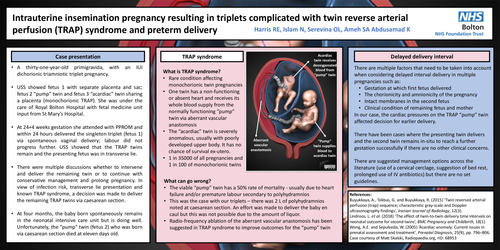
TRAP Syndrome
What is TRAP syndrome?
- Rare condition affecting monochorionic twin pregnancies
- One twin has a non-functioning or absent heart and receives its whole blood supply from the normally functioning ”pump” twin via aberrant vascular anastomosis
- The “acardiac” twin is severely anomalous, usually with poorly developed upper body. It has no chance of survival exutero.
- 1 in 35000 of all pregnancies and 1 in 100 of monochorionic twins
What can go wrong?
- The viable “pump” twin has a 50% rate of mortality - usually due to heart failure and/or premature labour secondary to polyhydramnios
- This was the case with our triplets – there was 2 L of polyhydramnios noted at caesarean section. An effort was made to deliver the baby en-caul but this was not possible due to the amount of liquor.
- Radio-frequency ablation of the aberrant vascular anastomosis has been suggested in TRAP syndrome to improve outcomes for the “pump” twin
Delayed delivery interval
There are multiple factors that need to be taken into account when considering delayed interval delivery in multiple pregnancies such as:
• Gestation at which first fetus delivered
• The chorionicity and amnionicity of the pregnancy
• Intact membranes in the second fetus
• Clinical condition of remaining fetus and mother
In our case, the cardiac pressures on the TRAP “pump” twin affected decision for earlier delivery. There have been cases where the presenting twin delivers and the second twin remains in-situ to reach a further gestation successfully if there are no other clinical concerns. There are suggested management options across the literature (use of a cervical cerclage, suggestion of bed rest, prolonged use of IV antibiotics) but there are no set guidelines.
References
Buyukkaya, A., Tekbas, G. and Buyukkaya, R. (2015) ‘Twin reversed arterial perfusion (trap) sequence; characteristic gray-scale and Doppler ultrasonography findings’, Iranian Journal of Radiology, 12(3).
Lindroos, L. et al. (2018) ‘The effect of twin-to-twin delivery time intervals on neonatal outcome for second twins’, BMC Pregnancy and Childbirth, 18(1)
Wong, A.E. and Sepulveda, W. (2005) ‘Acardiac anomaly: Current issues in prenatal assessment and treatment’, Prenatal Diagnosis, 25(9), pp. 796–806.
Case courtesy of Matt Skalski, Radiopaedia.org, rID: 68953