1,830 posters, 67 videos, 75 audios, 29 topics, 22 sessions, 4,727 authors, 1,697 institutions
ePostersLive by SciGen Technologies S.A. All rights reserved.
RCOG World Congress 2023
June 12 - 14, 2023 | London, UK

EP.1364
CONGENITAL HIGH AIRWAY OBSTRUCTION SYNDROME – NOT ALWAYS LETHAL- A CASE REPORT
Poster Presenter
Authors
Affiliations
Part of Topic
Fetal Medicine
CONGENITAL HIGH AIRWAY OBSTRUCTION SYNDROME – NOT ALWAYS LETHAL- A CASE REPORT DR.HIBA ARSHAD SHAIKH, DR. GHULAM ZAINAB, DR. AYESHA MALIK AGA KHAN UNIVERSITY HOSPITAL , PAKISTAN
INTRODUCTION
Congenital high airway obstruction syndrome (CHAOS) is a rare and highly lethal condition, with an incidence of 1 in 300,000 and multifactorial causes. This fetal condition carries a high perinatal mortality rate, reaching nearly 100% without timely intervention. If termination of pregnancy is not chosen due to the high mortality rate, delivery should take place in a tertiary care center. Treatment options include, in-utero fetoscopy and intervention, the ex utero - EXIT procedure, and post-delivery intubation/tracheostomy. Accurate antenatal diagnosis and counseling for postnatal management are crucial in achieving positive perinatal outcomes for patients who choose to continue their pregnancy.
CASE REPORT
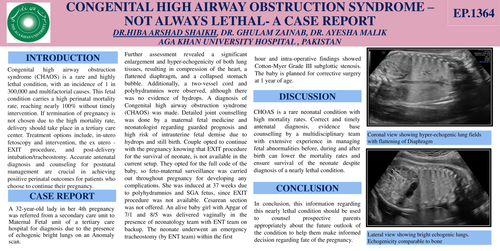
A 32-year-old lady in her 4th pregnancy was referred from a secondary care unit to Maternal Fetal unit of a tertiary care hospital for diagnosis due to the presence of echogenic bright lungs on an Anomaly scan.Further assessment revealed a significant enlargement and hyper-echogenicity of both lung tissues, resulting in compression of the heart, a flattened diaphragm, and a collapsed stomach bubble. Additionally, a two-vessel cord and polyhydramnios were observed, although there was no evidence of hydrops. A diagnosis of Congenital high airway obstruction syndrome (CHAOS) was made. Detailed joint counselling was done by a maternal fetal medicine and neonatologist regarding guarded prognosis and high risk of intrauterine fetal demise due to hydrops and still birth. Couple opted to continue with the pregnancy knowing that EXIT procedure for the survival of neonate, is not available in the current setup. They opted for the full code of the baby, so feto-maternal surveillance was carried out throughout pregnancy for developing any complications. She was induced at 37 weeks due to polyhydramnios and SGA fetus, since EXIT procedure was not available. Cesarean section was not offered. An alive baby girl with Apgar of 7/1 and 8/5 was delivered vaginally in the presence of neonatology team with ENT team on backup. The neonate underwent an emergency tracheostomy (by ENT team) within the first hour and intra-operative findings showed Cotton-Myer Grade III subglottic stenosis. The baby is planned for corrective surgery at 1 year of age.
DISCUSSION
CHOAS is a rare neonatal condition with high mortality rates. Correct and timely antenatal diagnosis, evidence base counselling by a multidisciplinary team with extensive experience in managing fetal abnormalities before, during and after birth can lower the mortality rates and ensure survival of the neonate despite diagnosis of a nearly lethal condition.
RESULTS
In conclusion, this information regarding this nearly lethal condition should be used to counsel prospective parents appropriately about the future outlook of the condition to help them make informed decision regarding fate of the pregnancy.