1,830 posters, 67 videos, 75 audios, 29 topics, 22 sessions, 4,727 authors, 1,697 institutions
ePostersLive by SciGen Technologies S.A. All rights reserved.
RCOG World Congress 2023
June 12 - 14, 2023 | London, UK

EP.1363
21/40 Rupture of Membranes in a Jehovah’s Witness with Placenta Praevia
Poster Presenter
Authors
Lauren Barnfield, Meena Nayagam, Rebecca McKay, Oluwafumbi Olajide
Affiliations
Part of Topic
High Risk Pregnancy
Introduction
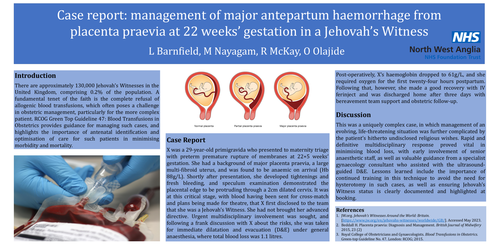
There are approximately 130,000 Jehovah’s Witnesses in the United Kingdom, comprising 0.2% of the population. A fundamental tenet of the faith is the complete refusal of allogenic blood transfusions, which often poses a challenge in obstetric management, particularly for the more complex patient. RCOG Green Top Guideline 47: Blood Transfusions in Obstetrics provides guidance for managing such cases, and highlights the importance of antenatal identification and optimisation of care for such patients in minimising morbidity and mortality.
Case Report
X was a 29-year-old primigravida who presented to maternity triage with preterm premature rupture of membranes at 22+5 weeks’ gestation. She had a background of major placenta praevia, a large multi-fibroid uterus, and was found to be anaemic on arrival (Hb 88g/L). Shortly after presentation, she developed tightenings and fresh bleeding, and speculum examination demonstrated the placental edge to be protruding through a 2cm dilated cervix. It was at this critical stage, with blood having been sent for cross-match and plans being made for theatre, that X first disclosed to the team that she was a Jehovah’s Witness. She had not brought her advanced directive. Urgent multidisciplinary involvement was sought, and following a frank discussion with X about the risks, she was taken for immediate dilatation and evacuation (D&E) under general anaesthesia, where total blood loss was 1.1 litres.
Post-operatively, X’s haemoglobin dropped to 61g/L, and she required oxygen for the first twenty-four hours postpartum. Following that, however, she made a good recovery with IV ferinject and was discharged home after three days with bereavement team support and obstetric follow-up.
Discussion
This was a uniquely complex case, in which management of an evolving, life-threatening situation was further complicated by the patient’s hitherto undisclosed religious wishes. Rapid and definitive multidisciplinary response proved vital in minimising blood loss, with early involvement of senior anaesthetic staff, as well as valuable guidance from a specialist gynaecology consultant who assisted with the ultrasound-guided D&E. Lessons learned include the importance of continued training in this technique to avoid the need for hysterotomy in such cases, as well as ensuring Jehovah’s Witness status is clearly documented and highlighted at booking.