1,830 posters, 67 videos, 75 audios, 29 topics, 22 sessions, 4,727 authors, 1,697 institutions
ePostersLive by SciGen Technologies S.A. All rights reserved.
RCOG World Congress 2023
June 12 - 14, 2023 | London, UK

EP.1362
Management challenges in Gastroschisis with severe Early onset fetal growth restriction
Poster Presenter
Authors
Affiliations
Part of Topic
Fetal Medicine
Management challenges in Gastroschisis with severe Early onset fetal growth restriction.
Misbah Malik1, Deborah Morgante2, Sanja Besorovic3, Uma Rajesh4
CASE REPORT:
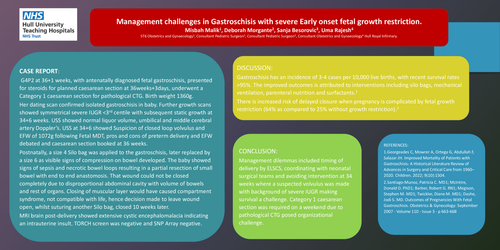
G4P2 at 36+1 weeks, with antenatally diagnosed fetal gastroschisis, presented for steroids for planned caesarean section at 36weeks+3days, underwent a Category 1 caesarean section for pathological CTG. Birth weight 1360g.
Her dating scan confirmed isolated gastroschisis in baby. Further growth scans showed symmetrical severe IUGR <3rd centile with subsequent static growth at 34+6 weeks. USS showed normal liquor volume, umbilical and middle cerebral artery Doppler’s. USS at 34+6 showed Suspicion of closed loop volvulus and EFW of 1072g following Fetal MDT, pros and cons of preterm delivery and EFW debated and caesarean section booked at 36 weeks.
Postnatally, a size 4 Silo bag was applied to the gastroschisis, later replaced by a size 6 as visible signs of compression on bowel developed. The baby showed signs of sepsis and necrotic bowel loops resulting in a partial resection of small bowel with end to end anastomosis. That wound could not be closed completely due to disproportional abdominal cavity with volume of bowels and rest of organs. Closing of muscular layer would have caused compartment syndrome, not compatible with life, hence decision made to leave wound open, whilst suturing another Silo bag, closed 10 weeks later.
MRI brain post-delivery showed extensive cystic encephalomalacia indicating an intrauterine insult. TORCH screen was negative and SNP Array negative
DISCUSSION:
Gastroschisis has an incidence of 3-4 cases per 10,000 live births, with recent survival rates >95%. The improved outcomes is attributed to interventions including silo bags, mechanical ventilation, parenteral nutrition and surfactants.1
There is increased risk of delayed closure when pregnancy is complicated by fetal growth restriction (64% as compared to 25% without growth restriction).2
CONCLUSION:
Management dilemmas included timing of delivery by ELSCS, coordinating with neonatal surgical teams and avoiding intervention at 34 weeks where a suspected volvulus was made with background of severe IUGR making survival a challenge. Category 1 caesarean section was required on a weekend due to pathological CTG posed organizational challenge.